


Solar desalination plant
Classification of the type:
Key words:
Domestic sewage treatment equipment
The details of the product
Product introduction
Solar desalination plant is a system that uses solar energy to convert seawater into fresh water. Solar collectors convert sunlight into heat energy, heat seawater, and desalinate it using the principles of evaporation and condensation.
Solar desalination plant is an environmental protection equipment that integrates solar photovoltaic power generation technology, efficient drinking water, and domestic sewage treatment technology, and is equipped with leisure or office area and bathing related functions. It aims to use renewable energy to synergistically treat drinking water and sewage. While achieving efficient resource utilization and sustainable environmental development, work, leisure, and life needs are also solved in one stop.
Composition of solar desalination plant
Intelligent distributed solar drinking water purification system equipment is a comprehensive water supply treatment system equipment with well water, river water, and natural lakes as water sources. It is mainly composed of the following key modules:
Solar photovoltaic panel power generation module: This is the energy supply core in the system. It directly converts solar energy into electrical energy through the photovoltaic effect to provide power for the entire sewage treatment system. The area and number of photovoltaic panels depend on the energy consumption requirements of the treatment system. The solar photovoltaic panel power generation module has a folding function.
Battery group energy storage power supply module: used to store the electricity generated by the solar photovoltaic panel when there is sufficient light, ensuring that the system can continue to operate stably at night or on cloudy days when there is insufficient light. The power supply battery adopts stacked batteries, such as stacked lithium batteries, stacked colloidal batteries, stacked lead-acid batteries, etc.
Diesel power generation system module: equipped with high-performance, unattended intelligent generators to meet the power demand on rainy days or when there is insufficient light, so as to ensure the stable and reliable operation of the system device.
Ceramic membrane pretreatment system module: This module system adopts inorganic ceramic membranes of domestic and foreign first-line brands, with a filtration accuracy of 0.1μm, which can effectively remove suspended matter and colloidal substances. This module mainly includes: reaction water tank, water production tank, water production pump, backwash pump and offline cleaning system, process pipelines and pipe fittings valves, fully automatic operation management control module, etc.
Reverse osmosis deep purification system module: The product configuration adopts advanced reverse osmosis RO membranes of domestic and foreign first-line brands, and the purification system adopts multi-stage filtration and disinfection to meet the water use standards of drinking water to meet daily drinking water needs. Mainly include: raw water pump, security filter, high-pressure pump, membrane assembly and bracket, offline cleaning system, process pipeline and pipe fittings, valve, fully automatic operation management control module, etc.;
Control system module: usually includes microcomputer control system and remote communication system, which is used to automatically monitor and manage the entire sewage treatment process, including aeration time, backflow ratio, equipment operation status, etc., to achieve efficient and energy-saving automatic operation. The remote communication system allows remote monitoring and fault diagnosis, which is convenient for real-time management and maintenance.
Features of solar desalination plant
Energy saving and high efficiency: use free solar energy to reduce power consumption and reduce operating costs.
Environmental protection: reduce greenhouse gas emissions, no secondary pollution, in line with the green and low-carbon concept.
Fully automatic operation: equipped with automatic control system, automatically adjust the treatment process according to water quality and water quantity, and reduce manual intervention.
Small footprint, high integration: integrated design, easy installation and maintenance, suitable for a variety of sites, especially places with limited space. Convenient maintenance: modular design, filter material replacement and system maintenance are simple and fast.
Strong adaptability: wide treatment range, suitable for different scales of domestic sewage treatment needs such as scattered residential areas, villages, resorts, small towns, etc.
Application fields of solar desalination plants
Solar desalination systems are widely used in communities, residential areas, tourist attractions, beaches, islands and other places near the coastline, and can directly use seawater. Especially for those areas far away from the power grid or with insufficient power supply, it is an ideal choice for solving water treatment problems in remote areas.

Module structure of the auxiliary expansion system
WTEYA's equipment can be expanded into the following functional areas according to different user scenarios:
(1) Rest (leisure), office and other functional areas.
(2) Integrated bathroom and sanitary functional area.
System Features
•Energy-saving and high efficiency: Utilize free solar energy to reduce electricity consumption and operating costs.
•Environmentally friendly: Reduce greenhouse gas emissions, no secondary pollution, in line with the green and low-carbon concept.
•Automatic operation: Equipped with an automatic control system, it automatically adjusts the treatment process according to water quality and water volume, reduces manual intervention, and can achieve remote control.
•Small footprint and high integration: The integrated design is easy to install and maintain, suitable for various sites, especially areas with limited space.
•Easy maintenance: Modular design, filter material replacement and system maintenance are simple and fast.
Wide sources of drinking water: including surface water (such as rivers, lakes, reservoirs) and groundwater (extracted through wells)
•Strong adaptability: Wide treatment range, suitable for domestic sewage treatment needs of different sizes such as decentralized residences, rural areas, resorts, and small towns.
Application areas
The system is widely used in areas far from the power grid or with insufficient power supply, as well as communities, residential areas, tourist attractions, construction sites, etc. that pursue a green and low-carbon lifestyle. It is an ideal choice for solving the problem of drinking water and sewage treatment in remote areas, leisure places and construction sites. It is also an important technical equipment for promoting ecological civilization construction and environmental protection.
Solar water treatment and purification plant costing
How much does a Solar water treatment and purification plant cost? In order to calculate the cost accurately, we recommend that you fill out a questionnaire and then we will be able to prepare a commercial offer, taking into account all the features of your project. We are always ready to provide you with detailed information about the different models, their technical characteristics, performance. We offer a full range of services, from advice and assistance in selecting equipment to its supply, installation and configuration. Our goal is to provide you with the necessary equipment to effectively solve the water treatment problem in your specific situation.
So, you need to email us at info@wteya.com
Our manager will prepare an excellent quote for you
Technical principle
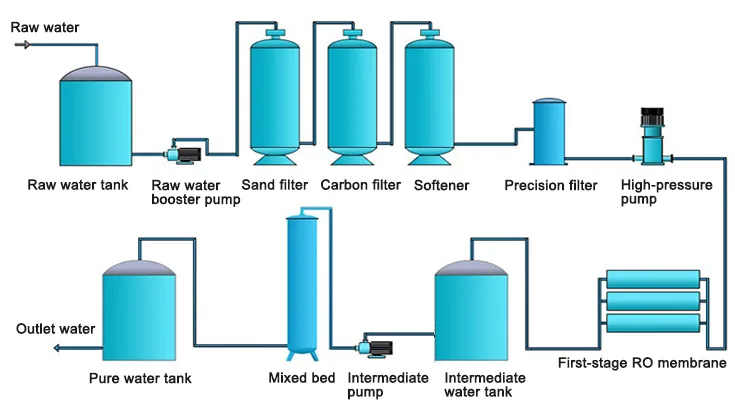
Technical principle of drinking water purification plant
Drinking water purification plant mainly treats sewage through the following steps:
1. Collection and pretreatment: First, collect domestic sewage, and remove large suspended solids and impurities through simple pretreatment such as grid and sedimentation.
2. Power supply system module: The built-in solar photovoltaic panels in the system convert solar energy into electrical energy, which is stored in the battery for use in the entire sewage treatment system, including energy-consuming links such as stirring, aeration, and pumping. On rainy days, the diesel generator supplies power to the power equipment and charges the battery.
3. Ceramic membrane pretreatment system module: This module system uses a first-line brand inorganic ceramic membrane with a filtration accuracy of 0.1μm, which can effectively remove suspended solids and colloidal substances. This module mainly includes: reaction water tank, water production tank, water production pump, backwash pump and offline cleaning system, process pipelines and pipe fittings valves, fully automatic operation management control module, etc.
4. Reverse osmosis deep purification system module: The product configuration is advanced and uses a first-line brand reverse osmosis RO membrane. The purification system uses multi-stage filtration and disinfection to meet the water use standards for drinking water to meet daily drinking water needs. Mainly includes: raw water pump, security filter, high-pressure pump, membrane assembly and bracket, offline cleaning system, process pipeline and pipe fittings, valve, automatic operation management control module, etc.
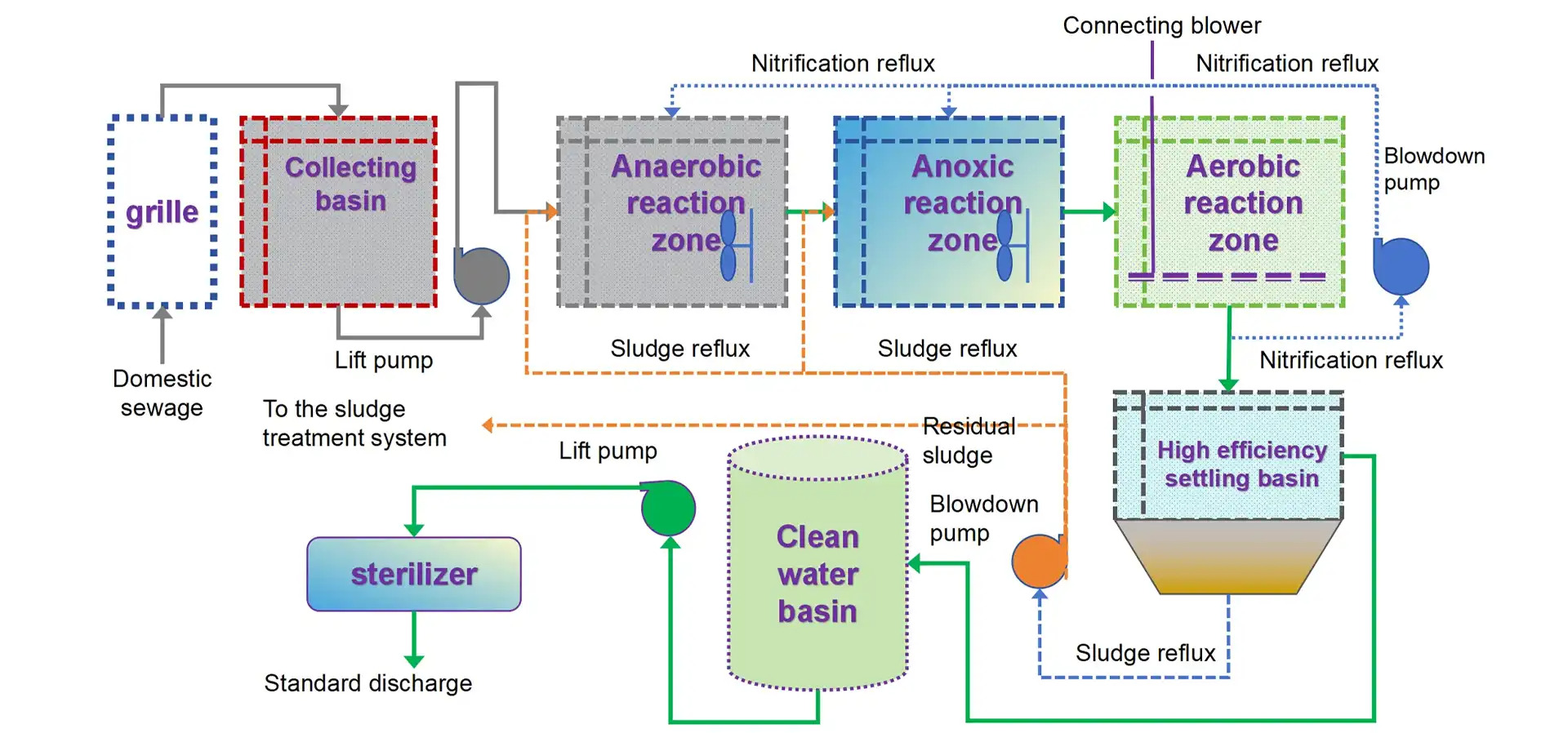
Technical principles of domestic sewage treatment plants
The domestic sewage treatment plant mainly treats sewage through the following steps:
1. Collection and pretreatment: First, collect domestic sewage, and then remove large suspended solids and impurities through simple pretreatment such as screens and sedimentation.
2. Solar power supply: The built-in solar photovoltaic panels in the system convert solar energy into electricity, which is stored in batteries for use in the entire sewage treatment system, including energy-consuming links such as stirring, aeration, and pumping.
3. Biochemical treatment: The core treatment part usually adopts biological treatment technology, such as activated sludge method, biofilm method (such as MBR membrane bioreactor) or anaerobic-aerobic (A/O) process, using microorganisms to decompose organic matter in sewage and remove nutrients such as nitrogen and phosphorus.
4. Deep purification: The water after biochemical treatment is further treated by deep treatment technologies such as sand filtration, activated carbon filtration or membrane filtration to further remove fine suspended solids and some soluble organic matter, and improve the effluent quality.
5. Disinfection: Finally, ultraviolet disinfection, ozone or chemical disinfectants are used to kill pathogens in the water to ensure the safety of effluent.
6. Reuse or discharge: The treated water can be used directly for non-potable purposes such as flushing and irrigation, or discharged into natural water bodies in compliance with local environmental discharge standards.
Process flow
Drinking water purification plant process flow
Domestic sewage treatment plant process flow
Our production

Model specifications
|
Island operation configuration Core functions: seawater desalination + domestic sewage treatment + photovoltaic energy storage system + diesel generator Installed power: 16.65kw+2.5KW Processing capacity: 1) Seawater desalination 2TPH, daily water output 10T. 2) Domestic sewage treatment 10TPD (using AO+MBR process) 3) Photovoltaic energy storage system: maximum photovoltaic power generation 36kw.h, energy storage battery: 60kw.h Main equipment: 5000*2200*2400 (H), the host comes with 12 photovoltaic panels, and the remaining photovoltaic panels can be expanded on site according to actual needs. Diesel generator: supplement the lack of solar energy
|
|
Unmanned area operation configuration Core functions: pretreatment system + domestic drinking water system + domestic sewage treatment + photovoltaic energy storage system + diesel generator Installed power: 2.42kw+2.95KW+2.5KW Processing capacity: 1) Pretreatment system 1TPH (using MCR flat membrane process). 2) Drinking water system 1TPH (using primary RO process). 3) Domestic sewage treatment 10TPD (using AO+MBR process). 4) Photovoltaic energy storage system: maximum photovoltaic power generation 26kw.h, energy storage battery: 60kw.h Main equipment: 5000*2200*2400 (H), the main unit comes with 12 photovoltaic panels, and the remaining photovoltaic panels can be expanded on site according to actual needs. Diesel generator: to supplement the lack of solar energy
|
Effect drawing

Frequently-asked questions
|
Questions |
Solutions |
|
Reduced efficiency of solar photovoltaic panels:
|
•Cause: There are stains, obstructions or aging on the surface of the photovoltaic panels. •Handling: Clean the photovoltaic panels regularly, remove obstructions, check and replace aged or damaged photovoltaic panels. |
|
Insufficient battery energy storage:
|
•Cause: Battery aging, over-discharge or charging system failure. •Handling: Check the battery status and perform charging and discharging maintenance or replace the battery if necessary. Make sure the charging controller is working properly. |
|
Aeration system does not work or is inefficient:
|
•Cause: Aeration pump failure, aeration pipeline blockage or insufficient solar power supply. •Handling: Check whether the aeration pump is operating normally, clear the blocked pipeline, and ensure sufficient power supply. |
|
Control system failure:
|
•Cause: Circuit failure, sensor failure or control software problem. •Handling: Check the line connection, replace damaged sensors, and upgrade or restart the control system software. |
|
Decreased treatment efficiency of the biological treatment unit:
|
•Cause: Imbalance of biological flora, excessive influent load or improper nutrient ratio. •Handling: Adjust the influent flow rate and nutrient delivery, and re-cultivate or supplement biological strains if necessary. |
|
Outlet water quality does not meet the standard:
|
•Cause: Insufficient pretreatment, poor biological treatment effect, filtration system blockage or failure of disinfection unit. •Handling: Strengthen pretreatment, adjust biological treatment parameters, clean or replace filter media, and check the working status of disinfection equipment. |
|
System leakage:
|
•Cause: Loose or damaged pipe connections or aging seals. •Handling: Check and tighten or replace pipe connections, repair damaged parts, and replace aging seals. |
|
Winter operation problems:
|
•Cause: Low temperature causes photovoltaic panel efficiency to decrease, water body to freeze or equipment to crack. •Handling: Take antifreeze measures, such as insulation wrapping and adding antifreeze to ensure that the temperature of key components is appropriate. |
|
Drinking water outlet deteriorates
|
•Cause: MCR and RO membrane systems are blocked. •Handling: (1) Check whether the MCR membrane system is damaged and replace damaged membranes in time. (2) Clean the RO membrane system and replace the membrane core that is not cleaned properly or damaged in time. |
Application field of evaporator
Get a free quote!
Let professionals help you choose
Guangdong WTEYA Environmental Technology Co., Ltd
Contact us
WhatsApp: +86 1800 2840 855
Tel: +86-0769-28636053
+86-0769-28636126
Email: info@wteya.com
Add: Floor 14, F4 building, TianAn digital town,
Nancheng District, Dongguan,Guangdong, China