


MVR vs Multi-Effect Evaporator: Which Fits Your Plant?
Release Time:
2026-09-12 09:05

MVR vs Multi-Effect Evaporator: Which Fits Your Plant?
Both MVR and multi-effect evaporation do the same job: they take water out of a concentrated stream and leave you with a manageable brine or a crystallised salt. The difference is how you pay for that evaporation — one route buys steam, the other buys electricity. Understanding that single trade-off is usually enough to select the right process for a given site.
This comparison sets out the numbers behind the two options, drawn from WTEYA project experience across more than 2,000 industrial installations, and gives you a simple framework for deciding.

⚙️ How the Two Technologies Reuse Heat
A multi-effect evaporator uses the secondary vapour leaving one effect as the heating medium for the next. With three effects, roughly 0.3 to 0.4 tonnes of live steam are still needed for every tonne of water evaporated, because the energy is reused only a limited number of times.
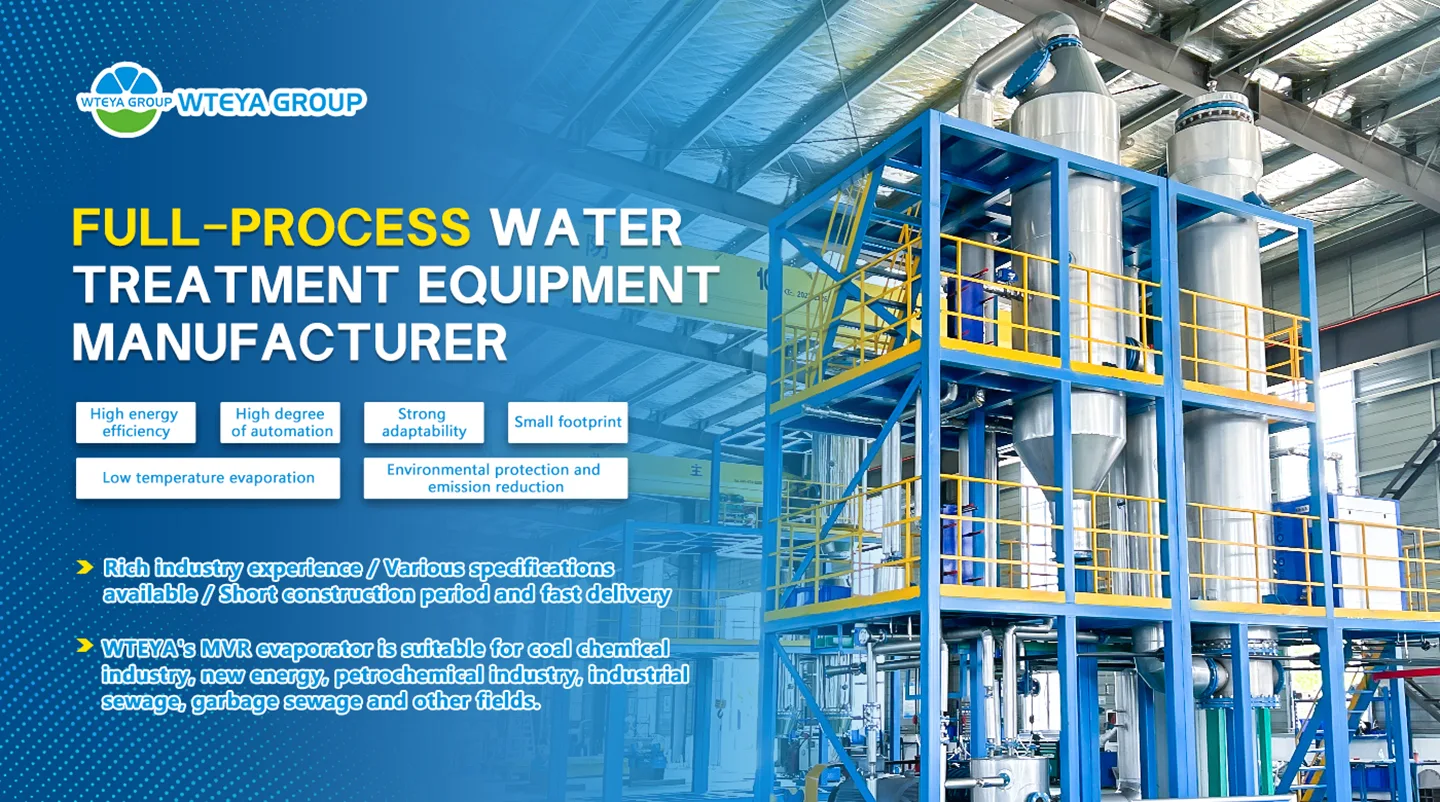
An MVR evaporator replaces the steam header with a compressor. It lifts the pressure and temperature of the secondary vapour and returns it to the heating side of the same exchanger, so the same energy is recycled continuously. Live steam is needed only for start-up and to cover heat losses — normally 0.02 to 0.05 tonnes per tonne of water, and often nothing at all in steady operation.
In short: multi-effect reuses steam in stages, MVR reuses it mechanically and indefinitely.
⚡ Energy and Operating Cost Compared
For a typical 10 t/h evaporation duty, the trade-off is easy to see:
- MVR electricity consumption: 25 to 45 kWh per tonne of water evaporated, with 35 kWh/t as the usual design point.
- Three-effect evaporation: about 0.33 tonnes of steam per tonne of water — roughly CNY 66 per tonne at a steam price of CNY 200/t.
- Annual running cost at 72,000 t/y: about CNY 2.0 to 2.6 million for MVR against CNY 4.5 to 5.0 million for three-effect.
Liquors with a high boiling point rise are the exception. Calcium chloride and lithium chloride brines can push MVR consumption to 60 to 80 kWh/t, because the compressor must work across a larger temperature lift. Even then MVR usually stays ahead wherever steam is expensive.
Electricity price is the other lever. At 0.6 to 1.0 CNY/kWh, MVR energy cost lands between CNY 15 and 45 per tonne of water treated.
💰 Capital Cost, Footprint and Turndown
MVR equipment costs 30 to 50% more up front than a comparable multi-effect train, because of the compressor, the larger motors and the tighter control system. Two factors repay that premium:
- Footprint. A multi-effect unit is a tower group; an MVR system is essentially one machine skid, which matters when floor space or structural loading is tight.
- Turndown and automation. A centrifugal-compressor MVR system runs comfortably between 50% and 110% of design load with variable-frequency control and PLC supervision, so it follows a fluctuating production schedule instead of being switched on and off.
Set against that, the compressor is the component that demands the most disciplined maintenance — high-speed bearings, oil quality and vibration monitoring all matter.
🏭 Matching the Technology to the Site
Neither route wins everywhere. The decision usually comes down to four questions:
- Is there cheap steam? If a plant already has surplus or waste steam and the duty is small, multi-effect is the lower-cost answer. If steam is bought in at CNY 200/t or more, MVR is normally the better investment.
- How large is the duty? Above roughly 5 t/h the economics of MVR are strong. Below 3 t/h, MVR capital per tonne is high and payback lengthens; a single-effect or heat-pump arrangement can be more sensible.
- Is steam available at all? On remote sites or in parks with no boiler, MVR is effectively the only option, because it can run on electricity alone.
- How does the material behave? A high boiling point rise points to a Roots or screw compressor; scaling and crystallising liquors point to a forced circulation heater. These choices sit alongside the MVR-versus-MED decision rather than replacing it.
The industry has already voted with its order books: more than 60% of newly built evaporation plants now use MVR. That said, selection should follow a full lifecycle cost calculation using your own electricity and steam prices, not a preference for one technology.
🏆 Why Choose WTEYA
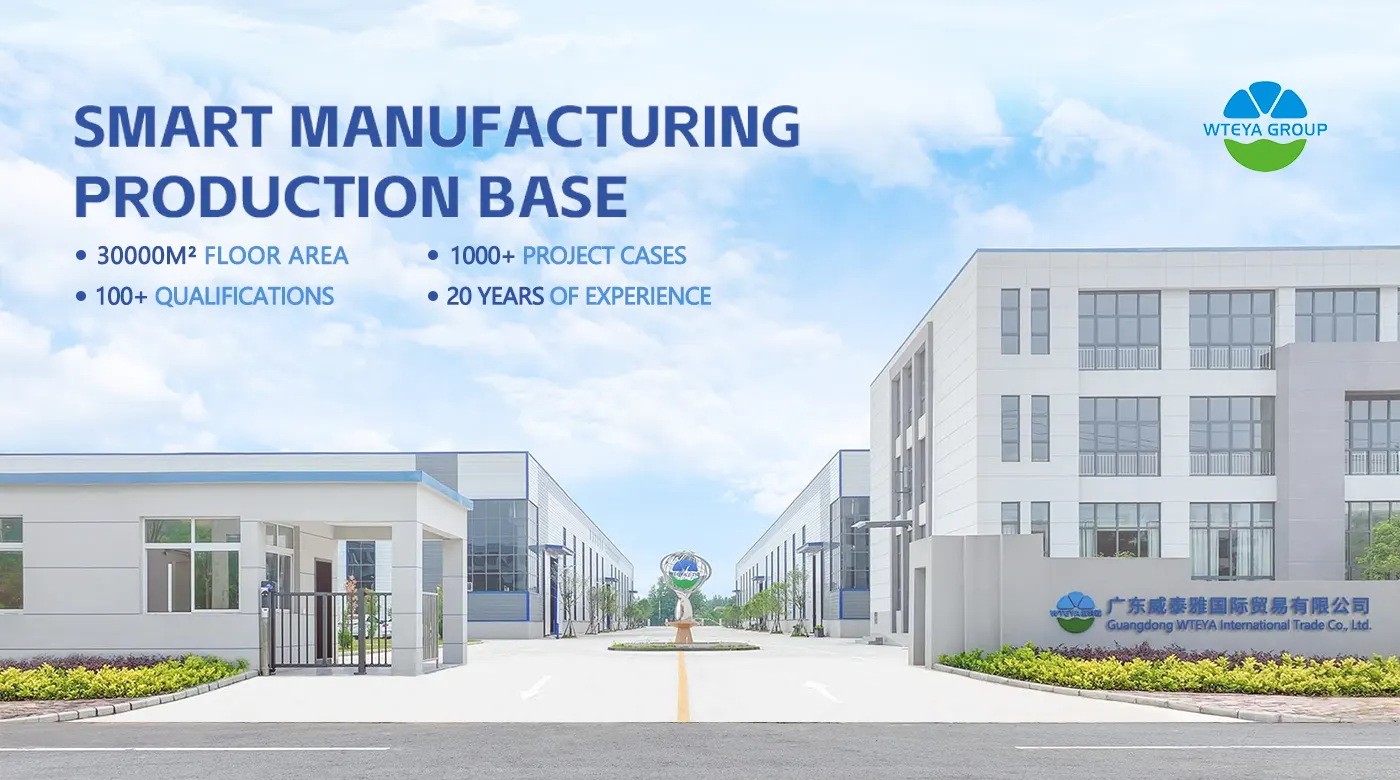
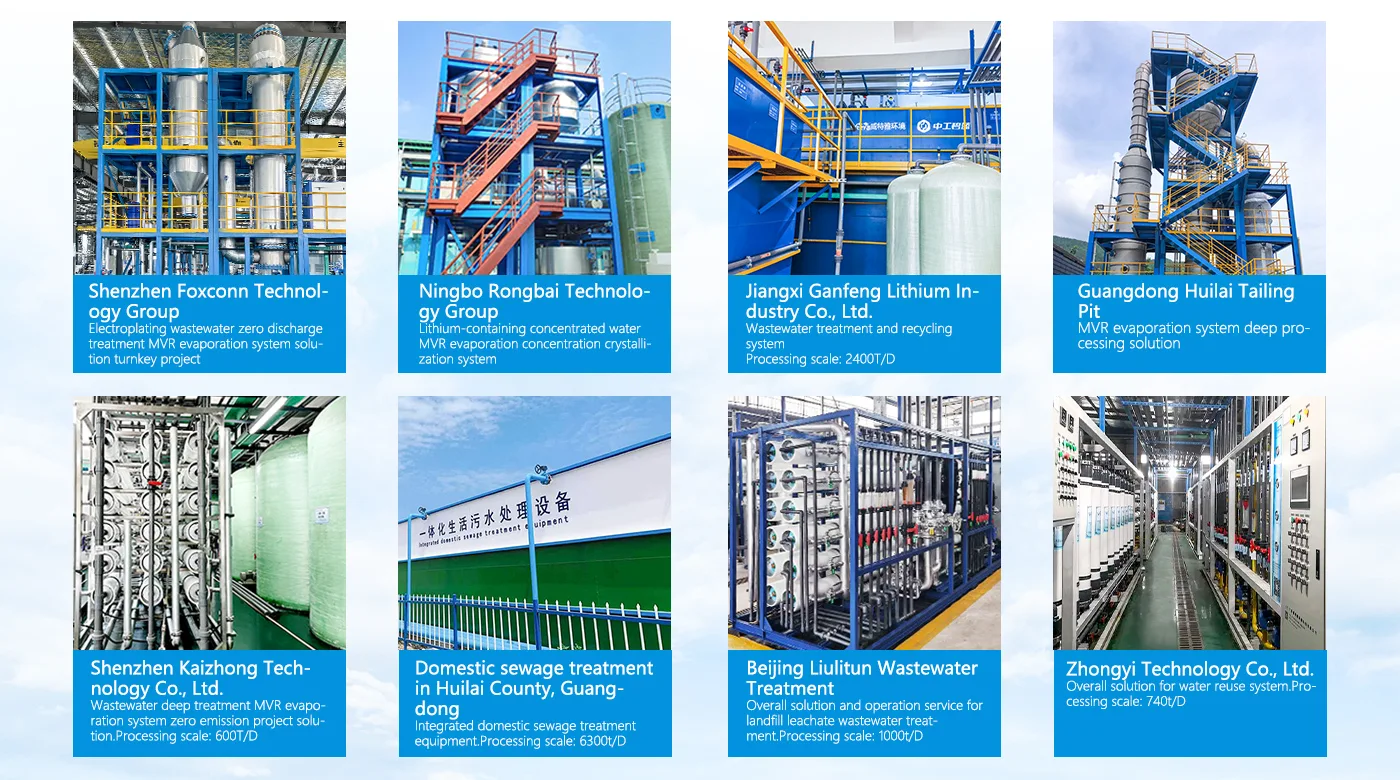
WTEYA builds both routes — MVR, multi-effect, forced circulation and crystallisation — so the recommendation you receive is based on your liquor, your energy prices and your site, not on a single product line. With nearly 20 years in evaporation and more than 2,000 customers served, we handle everything from pilot testing and process design to manufacturing, installation and operator training.
Every system is engineered to order: capacity, materials of construction, pretreatment, automation and layout are all matched to the actual duty. We also provide full OEM and ODM manufacturing for partners who need private-label evaporation equipment.
Frequently Asked Questions
A: MVR (Mechanical Vapor Recompression) evaporator is an energy-efficient evaporation technology that reduces energy consumption by 30-50% compared to traditional evaporation.
Q: How much energy can MVR save?
A: MVR evaporators typically reduce energy consumption by 30-50% compared to traditional multi-effect evaporators, using electricity instead of steam.
Q: What is the difference between MVR and multi-effect evaporator?
A: MVR uses mechanical vapor recompression for energy efficiency, while multi-effect evaporators use multiple evaporation stages. MVR has lower operating costs.
Ready to Reduce Your Environmental Footprint?
Every day of delay costs money. Our rapid-response team can deliver a preliminary solution design within 48 hours.
Send us your wastewater data and let's start building your custom system today.
📱 WhatsApp: +86-1800 2840 855
✉ Email: info@vteya.com
🌐 Website: www.vteya.com
Front page of Cross
Next go-to page
Related information
Can an MVR Evaporator Fit in an Existing Building?
Can an MVR Evaporator Fit in an Existing Building? Retrofitting an MVR evaporator into a building that already exists is one of the most common requests we receive, and the answer is not a simple yes or no.
MVR Evaporator for Salt Lake Lithium Extraction
MVR Evaporator for Salt Lake Lithium Extraction Salt lake brine is one of the lowest-cost lithium sources in the world, but it is also one of the most awkward fluids to concentrate.
Cutting Fluid Wastewater: MVR Evaporation and Zero Discharge
⚙️ Why Spent Emulsion Resists Conventional Treatment Every machining line that uses water-miscible coolant eventually produces a waste stream that cannot be sewered, cannot be burned as-is, and cannot be treated biologically without a fight.
MVR Evaporator Condensate Reuse: Quality and Options
MVR Evaporator Condensate Reuse: Quality and Options The condensate produced by an MVR evaporator is not a waste stream to be disposed of — it is distilled water of consistent quality.
MVR Evaporator Troubleshooting: Common Problems and Fixes
MVR Evaporator Troubleshooting: Common Problems and Fixes MVR evaporators are mechanically simple compared with steam-driven evaporator trains, but they are sensitive to small changes in vacuum, scaling and compressor stability.
Crystallization for Battery Material Wastewater Recovery
Crystallization for Battery Material Wastewater Recovery Battery manufacturing is a wet chemistry business. Cathode active material plants producing lithium iron phosphate or nickel-cobalt-manganese chemistries, and hydrometallurgical recycling lines recovering metals from spent cells, all consume...
Guangdong WTEYA Environmental Technology Co., Ltd
Contact us
WhatsApp: +86 1800 2840 855
Tel: +86-0769-28636053
+86-0769-28636126
Email: info@wteya.com
Add: Floor 14, F4 building, TianAn digital town,
Nancheng District, Dongguan,Guangdong, China