


MVR vs Single Effect Evaporator: Energy Consumption Compared
Release Time:
2026-11-09 09:08

MVR vs Single Effect Evaporator: Energy Consumption Compared
Evaporation is an energy business. Whichever evaporator you install, the plant will spend most of its operating budget turning water into vapor and then getting rid of that vapor. The real architectural decision is not the vessel, the tube bundle or the control system — it is which energy currency you pay in. A single effect evaporator pays in steam; a mechanical vapor recompression (MVR) system pays in electricity. Comparing the two on the same duty usually produces a difference of one order of magnitude in running cost, and that difference decides whether a project pays back in eighteen months or never.
This comparison sets out the physics behind that gap, the numbers you can use for a first-pass estimate, and the operating conditions where the cheaper option is not the one with the compressor.

⚡ The Energy Basis: Steam Versus Electricity
Every kilogram of water that leaves an evaporator must absorb its latent heat of vaporization — roughly 2,260 kJ/kg at 100 °C, and slightly more at lower temperatures. In a single effect evaporator that heat is supplied once by fresh steam and then thrown away in the condenser. The steam economy of the machine therefore sits close to 0.8–1.1 kg of distillate per kg of steam, with a well-designed preheater train pushing it to about 1.2.
MVR breaks that one-to-one relationship. Instead of generating new vapor with new steam, the compressor takes the vapor already produced, raises its pressure by a modest ratio (typically 1.2–1.6), and returns it to the heating side of the same vessel. The latent heat is used again. The machine no longer buys heat; it buys the small amount of work needed to lift the vapor temperature by 6–12 K.
That work is measured in kilowatt-hours, and it is where the whole economics of the comparison lives: a well-run MVR evaporator consumes 20–45 kWh per cubic meter of distillate, while a single effect unit consumes 1.1–1.3 tonnes of steam for the same cubic meter.
🔥 How a Single Effect Evaporator Spends Energy
A single effect evaporator is the simplest evaporator architecture: one boiling vessel, one heating bundle, one condenser. Liquid is boiled either at atmospheric pressure near 100 °C or under vacuum at 60–80 °C when the product is heat-sensitive. Steam condenses on one side of the tube wall; the process liquid boils on the other; the vapor produced goes to a condenser and leaves the plant as warm cooling water.
The energy balance is brutally simple. For every tonne of water evaporated, the plant needs about 1.1–1.3 tonnes of steam, plus the pumping energy to circulate the liquid and pull the vacuum — usually 5–15 kWh per tonne. It also needs 20–40 cubic meters of cooling water per tonne evaporated, because the condenser has to reject almost the entire latent heat that was just purchased.
What the design lacks in efficiency it repays in robustness. There is no compressor to erode, no rotor to balance and no tight temperature difference to respect. Slurries, crystallizing liquors, foaming products and heavily scaling streams are all handled with large-diameter tubes and generous residence time. For duties below about 5 tonnes per hour, and for plants that run a few hundred hours a year, that simplicity is often worth more than the steam bill.
♻️ How MVR Recovers the Latent Heat
An MVR system inserts a compressor between the vapor outlet and the heating steam inlet of the same vessel. Vapor leaving the boiling liquid at, say, 80 °C is compressed to a saturation temperature of 88–92 °C and then condenses inside the heating bundle, giving back its latent heat to the boiling liquid on the other side. The condensate leaves as clean distillate; there is no condenser duty and essentially no cooling water demand.
The compressor is normally a centrifugal blower for large flows or a roots-type machine for smaller ones. Its specific power depends mainly on the temperature lift: at a lift of 6–8 K the compressor draws roughly 15–22 kWh per tonne of vapor; at 10–12 K the figure rises to 25–32 kWh per tonne. Because the vapor is reused rather than discarded, the coefficient of performance of the evaporation loop — heat delivered to the boiling liquid divided by compressor work — typically lands between 10 and 20.
The practical consequences are as important as the arithmetic. An MVR evaporator has no cooling water system, no steam boiler demand beyond start-up and trim, and a much smaller footprint. In exchange it has a rotating machine that must be protected from droplets, a control system that must keep the temperature lift stable, and a heat exchanger that must be kept clean — a fouled bundle raises the required lift, and every extra degree of lift is paid for in compressor power.
📊 Side-by-Side Numbers on the Same Duty
Placed on an identical duty — say 10 tonnes per hour of water to be evaporated from a saline stream — the two architectures diverge as follows.
- Steam consumption: 1.1–1.3 t per tonne evaporated for single effect; 0.05–0.15 t for MVR, used only for start-up, trim heating and deaeration.
- Electricity for compression: none in single effect beyond pumps (5–15 kWh/t); 20–45 kWh/t in MVR, depending on boiling point elevation and temperature lift.
- Cooling water: 20–40 cubic meters per tonne evaporated for single effect; close to zero for MVR.
- Typical capacity range: 0.5–10 t/h for single effect; 1–100 t/h for MVR, where the compressor efficiency improves with size.
- Turn-down: 30–100% for single effect; 50–100% for MVR, because the compressor has a surge limit.
- Fouling and crystallization: single effect tolerates heavy scaling and slurries; MVR usually needs a forced circulation arrangement to keep crystals suspended.
- Indicative operating cost at 25 USD/t steam and 0.10 USD/kWh: about 30 USD per tonne evaporated for single effect, against 3–5 USD per tonne for MVR.
Those operating figures are the reason MVR dominates new-build industrial wastewater evaporation. But they are not universal, and the exceptions matter.
💡 When the Electricity Bill Still Wins
MVR loses its advantage when the temperature lift becomes large. High dissolved solids, and especially salts with a steep boiling point elevation, force the compressor to work across 15–20 K instead of 8 K. Specific power can then climb above 50 kWh per tonne, and the coefficient of performance collapses toward the range of a multi-effect system. For saturated brines near crystallization, a hybrid of medium-temperature evaporation and mechanical recompression is usually more stable than pure MVR.
Scale is the second limit. Below roughly 1 tonne per hour, the compressor, its lubrication system, its surge control and its noise enclosure become a large share of capital cost. If the plant runs 500 hours a year on a seasonal duty, the steam saved will never repay that equipment. A single effect evaporator, or a small multi-effect unit, is the rational choice.
Utility prices decide the rest. Where electricity exceeds about 0.20 USD/kWh and steam is cheap or already available as waste heat from another process, the operating-cost gap narrows sharply. Where steam must be generated in a gas boiler at 25–40 USD per tonne, MVR wins almost regardless of the electricity tariff.
🔧 Hybrid Designs That Beat Both
Most modern projects do not choose one architecture in isolation. Three hybrid configurations are common.
- MVR retrofit of an existing single effect evaporator: the vessel, tube bundle and circulation pump stay; a compressor is added on the vapor line and the condenser is converted to a vent condenser. Steam consumption typically falls by 80–90% at a fraction of the cost of a new train.
- Multi-effect plus MVR: the last effect operates under vacuum and its vapor is recompressed to drive the first effect. This keeps the steam economy of a multi-effect train while removing most of its steam demand.
- Thermocompression plus MVR: a steam ejector handles the bulk of the lift and the mechanical compressor trims the remainder, which is useful where medium-pressure steam is available but expensive.
📐 Choosing by Capacity and Utility Prices
A first-pass screening rule works surprisingly well. Above 3–5 tonnes per hour of continuous evaporation, with electricity below about 0.15 USD/kWh, MVR is almost always the lower-cost lifecycle choice. Between 1 and 3 tonnes per hour, the answer depends on whether steam is already on site: with an existing boiler and cheap fuel, a single effect or small multi-effect unit can be competitive; without one, MVR avoids a boiler investment altogether. Below 1 tonne per hour, or for intermittent duties, simplicity usually wins.
Run the payback before committing. For a 10 t/h plant at 8,000 hours a year, a single effect unit burns roughly 96,000 tonnes of steam annually; at 25 USD per tonne that is 2.4 million USD. An MVR unit on the same duty draws about 2.4 million kWh, costing roughly 240,000 USD at 0.10 USD/kWh, plus maintenance. The capital premium of the MVR train is typically recovered in well under two years — which is why the decision usually comes down to steam availability and power quality rather than to first cost.
🏆 Why Choose WTEYA?
Why Choose WTEYA?
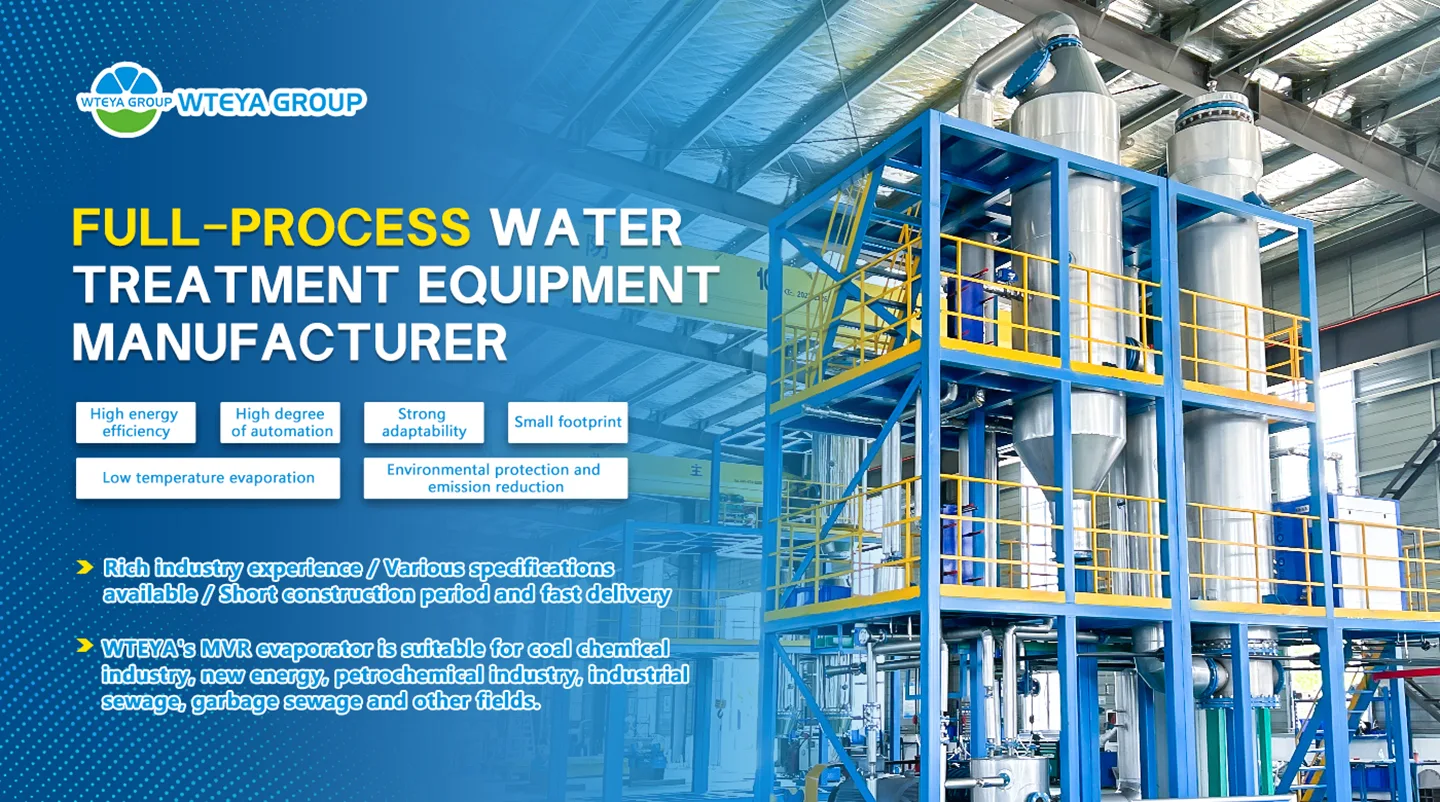
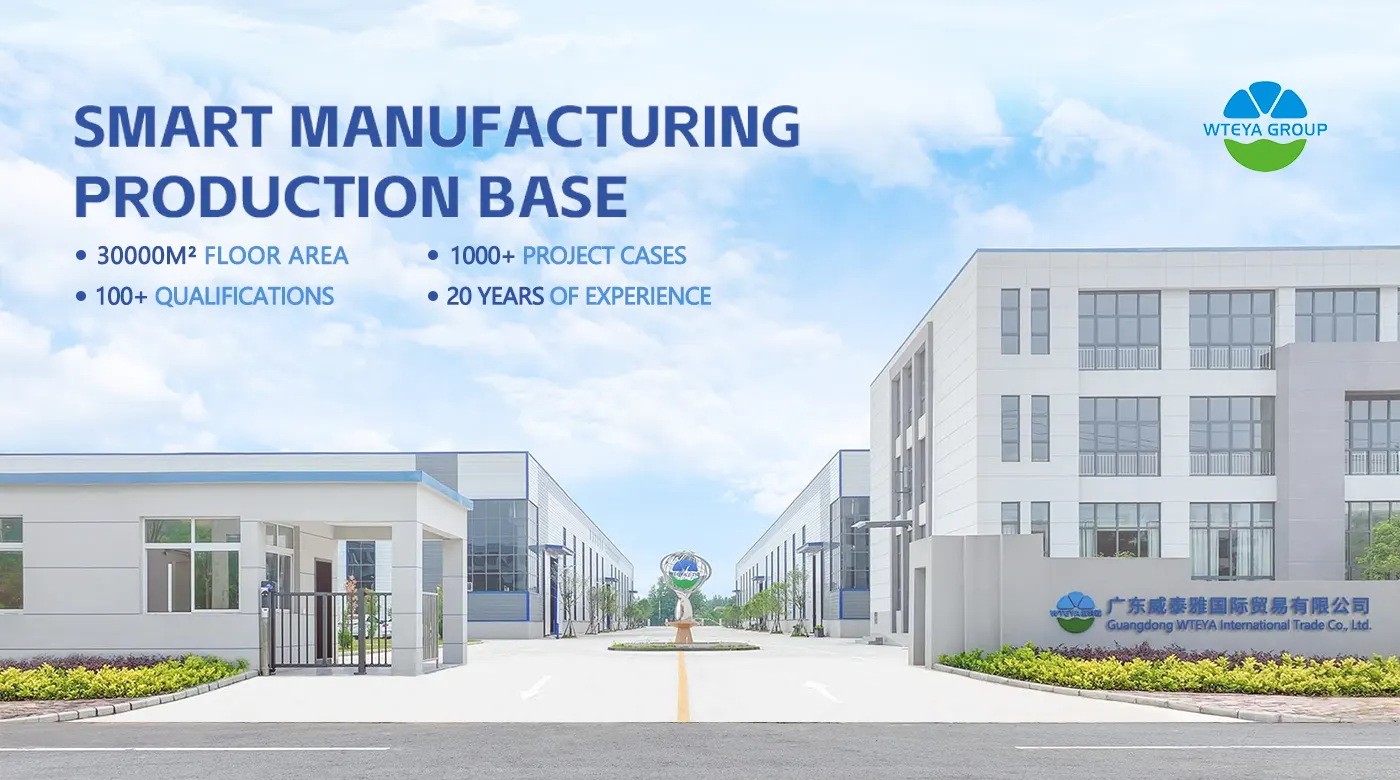
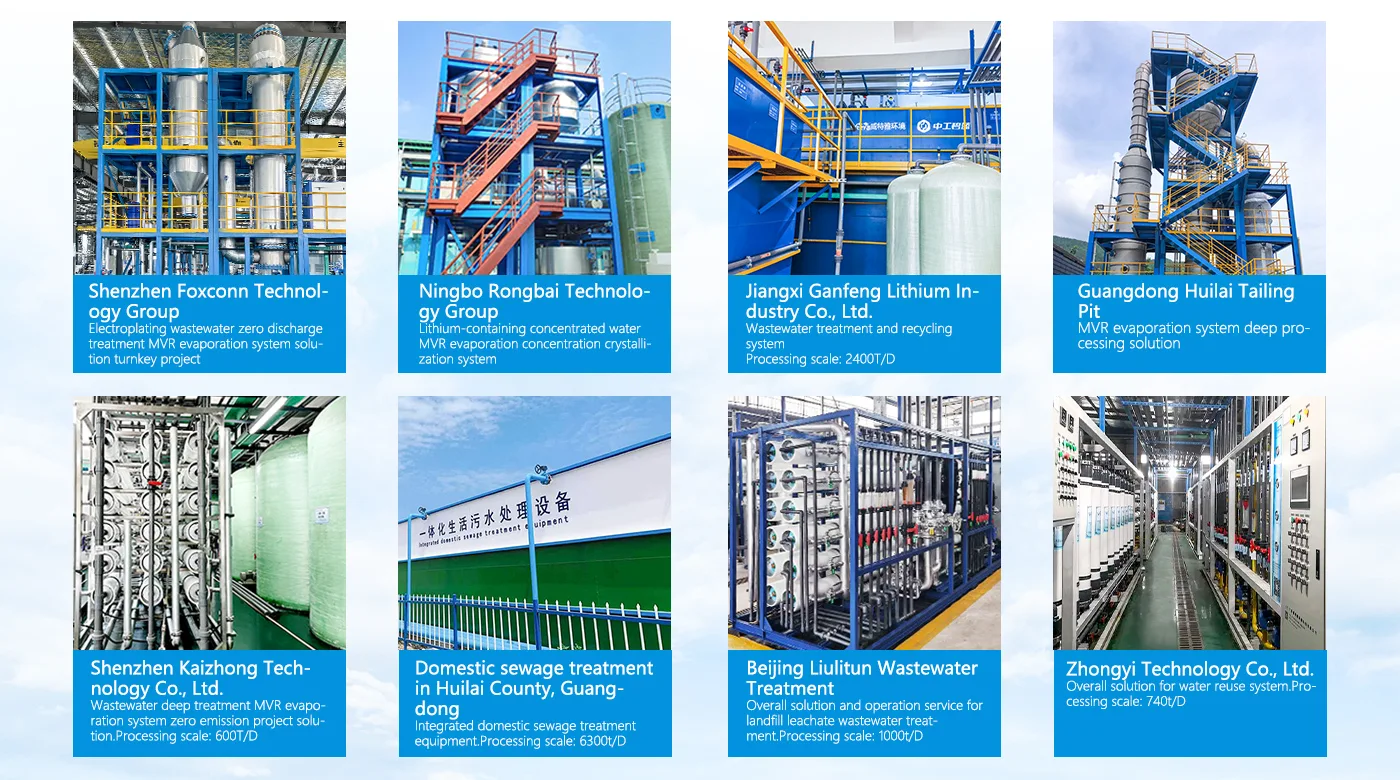
WTEYA has spent nearly 20 years building evaporation and crystallization systems for industrial wastewater, and more than 2,000 customers operate our equipment across chemical, electroplating, PCB, lithium, photovoltaic, metallurgical and landfill leachate applications. We manufacture the vessels, heat exchangers and skid packages in our own workshop, run pilot tests on real wastewater before fixing the design, and support both customized projects and full OEM & ODM programs. Whether the right answer for your duty is a single effect evaporator, an MVR train or a hybrid of the two, the comparison is made on your water analysis, your utility prices and your operating profile — not on a catalogue page.
Frequently Asked Questions
Q: What is an MVR evaporator?
A: MVR (Mechanical Vapor Recompression) evaporator is an energy-efficient evaporation technology that reduces energy consumption by 30-50% compared to traditional evaporation.
Q: How much energy can MVR save?
A: MVR evaporators typically reduce energy consumption by 30-50% compared to traditional multi-effect evaporators, using electricity instead of steam.
Q: What is the difference between MVR and multi-effect evaporator?
A: MVR uses mechanical vapor recompression for energy efficiency, while multi-effect evaporators use multiple evaporation stages. MVR has lower operating costs.
Transform Your Wastewater Management
Still using outdated treatment methods? Upgrade to WTEYA's advanced technology and see immediate improvements in efficiency and compliance.
Schedule a video call with our engineers to explore your options.
📱 WhatsApp: +86-1800 2840 855
✉ Email: info@vteya.com
🌐 Website: www.vteya.com
Front page of Cross
Next go-to page
Related information
MVR vs Single Effect Evaporator: Energy Consumption Compared
MVR vs Single Effect Evaporator: Energy Consumption Compared Evaporation is an energy business. Whichever evaporator you install, the plant will spend most of its operating budget turning water into vapor and then getting rid of that vapor.
Energy Recovery in Evaporation: 5 Ways to Save Steam
Energy Recovery in Evaporation: 5 Ways to Save Steam In an industrial evaporation plant, thermal energy is usually the largest single operating cost — commonly 60–80% of the total , ahead of electricity, labour and chemicals.
WTEYA Ships 10 SWRO4021 Portable Desalination Units to Puerto Rico
WTEYA GROUP has shipped 10 SWRO4021 portable desalination units to Puerto Rico, built for fast island and emergency water supply with low energy demand.
MVR Evaporator Installation: How Long It Really Takes
MVR Evaporator Installation: How Long It Really Takes Most buyers plan the shipment date carefully and then discover that the on-site installation is what sets the real start of production.
Hazardous Wastewater Evaporation: MVR Design and Compliance
Hazardous Wastewater Evaporation: MVR Design and Compliance Hazardous wastewater is the most demanding feed a thermal system will ever see. It arrives with unknown composition, extreme pH, solvents that flash at low temperature, and heavy metals that must not leave the site in a liquid stream.
LFP Cathode Wastewater: MVR Zero-Discharge Design
LFP cathode production wastewater carries 500-5,000 mg/L total phosphorus, 1,000-10,000 mg/L ammonia nitrogen and 10,000-50,000 mg/L sulfate.
Guangdong WTEYA Environmental Technology Co., Ltd
Contact us
WhatsApp: +86 1800 2840 855
Tel: +86-0769-28636053
+86-0769-28636126
Email: info@wteya.com
Add: Floor 14, F4 building, TianAn digital town,
Nancheng District, Dongguan,Guangdong, China