


ZLD System Design: Key Components and Benefits Explained
Release Time:
2026-05-13 18:02

ZLD System Design: Key Components and Benefits Explained
Industrial plants face mounting pressure to eliminate liquid waste discharge while keeping operating costs manageable. Zero Liquid Discharge (ZLD) systems offer a solution that recovers water for reuse and converts waste into solid form. Understanding the core components of a ZLD system helps plant managers make informed decisions about their wastewater treatment investments.
What Is a Zero Liquid Discharge System?
A ZLD system treats industrial wastewater to recover nearly all the water for reuse, leaving only solid residues for disposal. Traditional wastewater treatment often produces liquid effluent that requires expensive disposal or treatment. ZLD eliminates this discharge entirely by combining multiple treatment technologies in a closed-loop system.
Plants adopting ZLD achieve compliance with strict environmental regulations while reducing their freshwater consumption. The recovered water can be reused in production processes, cooling towers, or boiler feedwater applications.

Core Components of ZLD Systems
1. Pretreatment Unit
The pretreatment stage removes oils, suspended solids, and bulk contaminants from incoming wastewater. Common processes include:
- Oil-water separators remove floating oils and greases
- Chemical precipitation targets dissolved metals and hardness
- Clarification tanks settle out suspended particles
- pH adjustment systems prepare water for downstream processes
Proper pretreatment protects downstream equipment from scaling and fouling, extending system lifespan and reducing maintenance costs.
2. Membrane Systems
Reverse osmosis (RO) and nanofiltration (NF) membranes concentrate dissolved salts and organic compounds. The membrane stage typically includes:
- Brackish water RO units handle moderate salinity streams
- High-pressure RO systems treat concentrated brines
- Softening pretreatment prevents membrane scaling
Membranes can recover 60-85% of water as clean permeate for reuse. The concentrate stream moves to the final evaporation stage.
3. Evaporation and Crystallization
The evaporation stage handles the concentrated brine from membrane treatment. Modern ZLD systems typically use:
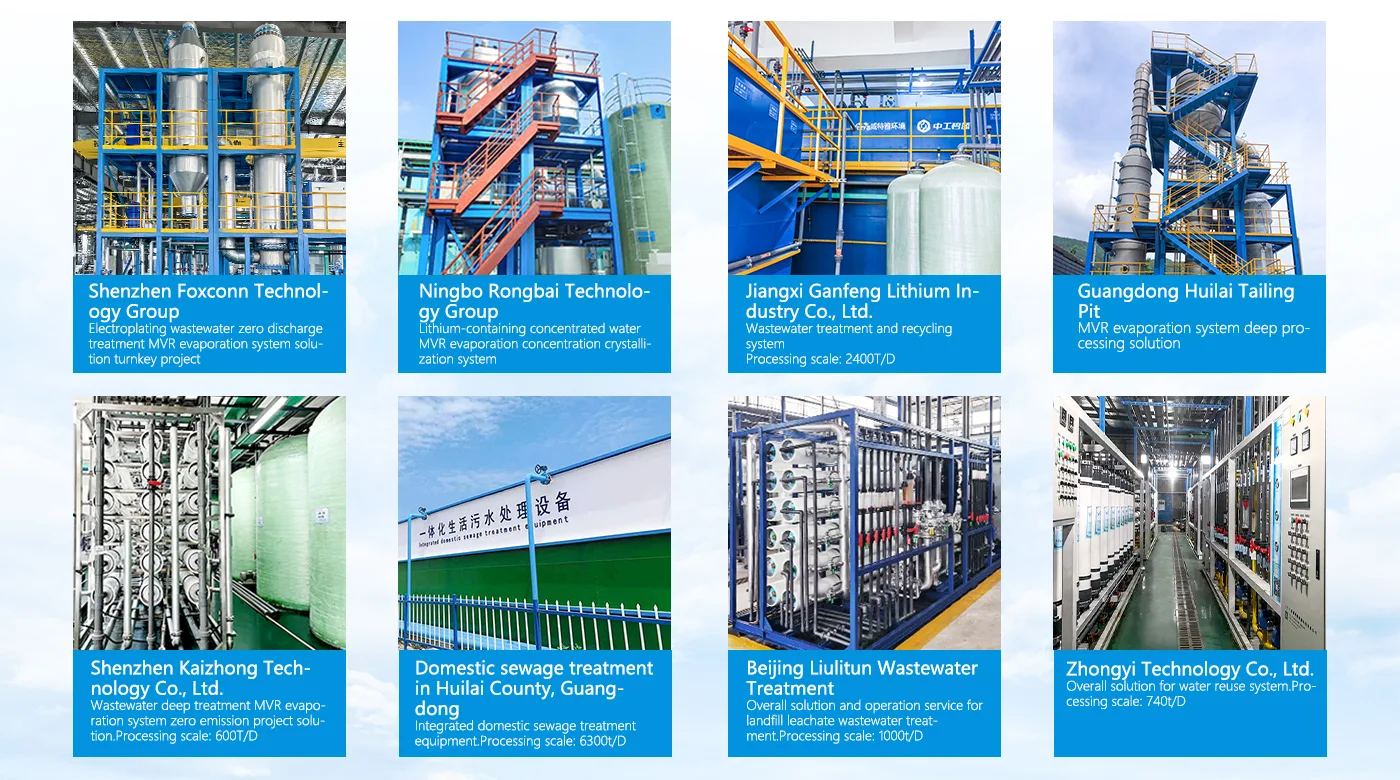
- Mechanical Vapor Recompression (MVR) evaporators recycle latent heat, reducing energy consumption by 30-60% compared to traditional evaporators
- Multi-effect evaporators cascade steam across multiple stages for efficiency
- Crystallization units produce dry solid salts from the final concentrate
This stage produces distilled water for recovery and solid residues suitable for landfill disposal or further processing.
Key Benefits of ZLD Systems
ZLD technology delivers measurable advantages for industrial facilities:
- Regulatory Compliance — Eliminates liquid discharge concerns entirely
- Water Recovery — Recovers 90-98% of wastewater for reuse
- Cost Savings — Reduces freshwater consumption and liquid disposal expenses
- Resource Recovery — Produces reusable salts and clean water
Plants recovering water through ZLD typically see freshwater consumption drop by 15-30%. The solid residues, often saleable salts like sodium sulfate, can offset treatment costs.
Why MVR Technology Matters
Modern ZLD systems increasingly rely on MVR evaporator technology for the evaporation stage. Unlike traditional multi-effect evaporators, MVR systems use mechanical compressors to reuse vapor, dramatically cutting energy costs.
A typical MVR system for ZLD applications consumes 20-35 kWh per ton of water evaporated, achieves 95%+ water recovery rates, handles high-salinity streams common in industrial applications, and requires less steam infrastructure than multi-effect units.
Choosing the Right ZLD Partner
Selecting an experienced ZLD system manufacturer impacts project success. Look for suppliers with proven track records in your specific industry, in-house engineering and fabrication capabilities, comprehensive after-sales support and spare parts availability, and references from similar installations.
WTEYA delivers ZLD systems backed by nearly 20 years of experience serving industrial plants across Asia. Our engineering team provides custom system design, installation supervision, and ongoing operational support.
Frequently Asked Questions
Q: What is Zero Liquid Discharge (ZLD)?
A: Zero Liquid Discharge (ZLD) is an advanced wastewater treatment process that eliminates all liquid waste from a facility, recovering up to 95-99% of water for reuse.
Q: How much does a ZLD system cost?
A: The cost of a ZLD system depends on capacity, industry, and specific requirements. Contact WTEYA for a customized quote.
Q: Which industries need ZLD systems?
A: Industries such as chemical manufacturing, electroplating, PCB/electronics, battery production, and textiles benefit most from ZLD systems.
Ready to Start Your Project?
Join industry leaders like Foxconn, BYD, and Huawei who trust WTEYA for their critical wastewater treatment needs.
Get the same expertise working for your zero liquid discharge facility. Contact us now.
📱 WhatsApp: +86-1800 2840 855
✉ Email: info@vteya.com
🌐 Website: www.vteya.com
Front page of Cross
Related information
WTEYA Extends Its Footprint in Korea's Lithium Battery Water Treatment Market
WTEYA expands in South Korea after hosting a lithium battery wastewater purification client serving SK, Samsung and LG. The company pairs nearly 20 years of experience with more than 2,000 delivered projects.
Zero Liquid Discharge: A Complete Guide for 2026
Zero Liquid Discharge: A Complete Guide for 2026 Zero liquid discharge (ZLD) has moved from a niche compliance tactic to a mainstream design requirement for water-intensive industries.
Wastewater Evaporation for the Photovoltaic Industry
Wastewater Evaporation for the Photovoltaic Industry Photovoltaic manufacturing is one of the fastest-growing industrial sectors in the world, and it is also one of the most water-intensive.
Mid-Autumn Greetings from WTEYA and Our 2026 Holiday Notice
WTEYA wishes clients and colleagues a happy Mid-Autumn Festival. Offices and the Jingshan plant observe the holiday from 25 to 27 September 2026, with duty engineers on site and service lines kept open.
Mid-Autumn Festival at WTEYA: Fruit Boxes and Mooncakes for Every Office
WTEYA prepares Mid-Autumn Festival gifts for all employees: seasonal fruit boxes for the group headquarters, and mooncakes for colleagues at the Jingshan manufacturing plant and branch sites nationwide.
WTEYA has shipped three 4040 seawater desalination units to Mexico under its cooperation with Rotoplas, a leading Latin American water solutions company, extending the company's Latin America channel and global delivery capability.
Guangdong WTEYA Environmental Technology Co., Ltd
Contact us
WhatsApp: +86 1800 2840 855
Tel: +86-0769-28636053
+86-0769-28636126
Email: info@wteya.com
Add: Floor 14, F4 building, TianAn digital town,
Nancheng District, Dongguan,Guangdong, China