


Evaporation Crystallizer: How It Works and When to Use It
Release Time:
2026-09-19 09:04

Evaporation Crystallizer: How It Works and When to Use It
An evaporation crystallizer sits at the very end of a zero liquid discharge line, where two questions have to be answered at once: where does the water go, and where does the salt go. The evaporator concentrates the brine until dissolved solids are pushed past their solubility limit, and the crystallizer then turns that concentrated brine into a dry, transportable salt instead of a liquid waste stream that costs money to haul away. This guide explains the mechanism behind the machine, the hardware inside it, and the conditions under which it is the right choice.
What an Evaporation Crystallizer Actually Does
A crystallizer is not simply a bigger evaporator. An evaporator removes water to reduce volume; a crystallizer deliberately drives the remaining dissolved salt into a solid phase and grows it into particles of a controlled size. In a zero liquid discharge train the evaporator does the bulk water removal and the crystallizer closes the loop, recovering the water as clean condensate and the salt as a solid product.
The numbers are what make it attractive. Water recovery in a well-designed crystallizer stage typically exceeds 98%, and the condensate produced is usually below 100 mg/L TDS, clean enough to be reused as cooling tower make-up or process water after light polishing. The recovered salt is not automatically waste either: treated sodium chloride can reach the specification of the by-product industrial grade standard and be sold as de-icing salt or as feed for chlor-alkali plants, while sodium sulfate finds use in detergents, glass and paper. Where mixed hazardous salts used to cost thousands of yuan per ton to dispose of, recovery can cut the hazardous residue volume by more than 90%.

The Working Principle: Supersaturation, Not Evaporation Alone
The single sentence that explains the technology is this: evaporate to create supersaturation, then crystallize out a product. The full sequence has six distinguishable steps.
- Supersaturation forms. Boiling off solvent raises the salt concentration above its solubility at that temperature, creating the driving force for crystallization.
- The metastable zone is respected. Operation is held above the solubility curve but below the nucleation line, so existing crystals grow instead of new nuclei forming. Keeping the relative supersaturation below roughly 0.2 to 0.3 is what separates engineered crystallization from simply boiling brine dry.
- Seed crystals lead the way. A controlled dose of seed crystals gives the dissolved salt a preferential surface to deposit on, which suppresses spontaneous nucleation and narrows the particle size distribution.
- Crystals grow. Slurry circulates through the crystallization chamber and the crystals absorb supersaturated solute, growing from tens of microns to hundreds.
- Classification and discharge. The coarsest crystals settle and accumulate in a classification or elutriation zone, are drawn off as slurry, and are dewatered in a centrifuge to give the finished salt. Fines are returned to grow further.
- Mother liquor recirculates. Centrate goes back to the crystallizer, and impurities such as calcium, magnesium, silica and organics concentrate in the loop until they are purged on a controlled basis.
That last point matters commercially. Because classification keeps fine crystals and impurity-laden mother liquor out of the product, by-product salt purity of 95% to 99% is achievable, with a narrow size distribution (coefficient of variation below 30%) and a wet-salt moisture content of 5% to 10% — free-flowing, non-caking and easy to handle.
Inside the Machine: Core Components
A production crystallizer is an assembly, not a single vessel. The heating chamber supplies the evaporation duty, typically as a shell-and-tube bundle in titanium, 2205 duplex stainless steel or 316L depending on chloride level. The crystallization chamber, built in OSLO or DTB configuration, is where supersaturation is released and crystals grow. An axial-flow circulation pump drives slurry through the loop, a vapor-liquid separator removes entrained droplets from the vapor, and the seed and elutriation system controls particle size. Downstream, a thickener and centrifuge dewater the salt, and a mother liquor return line closes the loop. Paired with a mechanical vapor recompression compressor or a multi-effect arrangement, the whole train becomes a continuous, largely automated plant.
When to Use an Evaporation Crystallizer
A crystallizer is not a universal waste disposal device. It belongs where salinity is high, composition is reasonably well understood, and there is value in recovering salt. Three screening criteria decide the fit.
First, salinity. As a rule of thumb, waste with total dissolved solids above 30,000 mg/L can be crystallized economically as-is, while streams below 10,000 mg/L should first be concentrated by membrane to reduce the evaporator load. Second, salt chemistry: single-salt systems based on sodium chloride or sodium sulfate are ideal, while genuinely mixed-salt brines need a fractionation feasibility study before the layout is fixed. Third, the pretreatment load: calcium and magnesium above 500 mg/L and silica above 100 mg/L must be removed upstream, and chemical oxygen demand above 1,000 mg/L has to be oxidized or biologically treated first, otherwise foaming and organics contamination will degrade the product salt and destabilize the process.
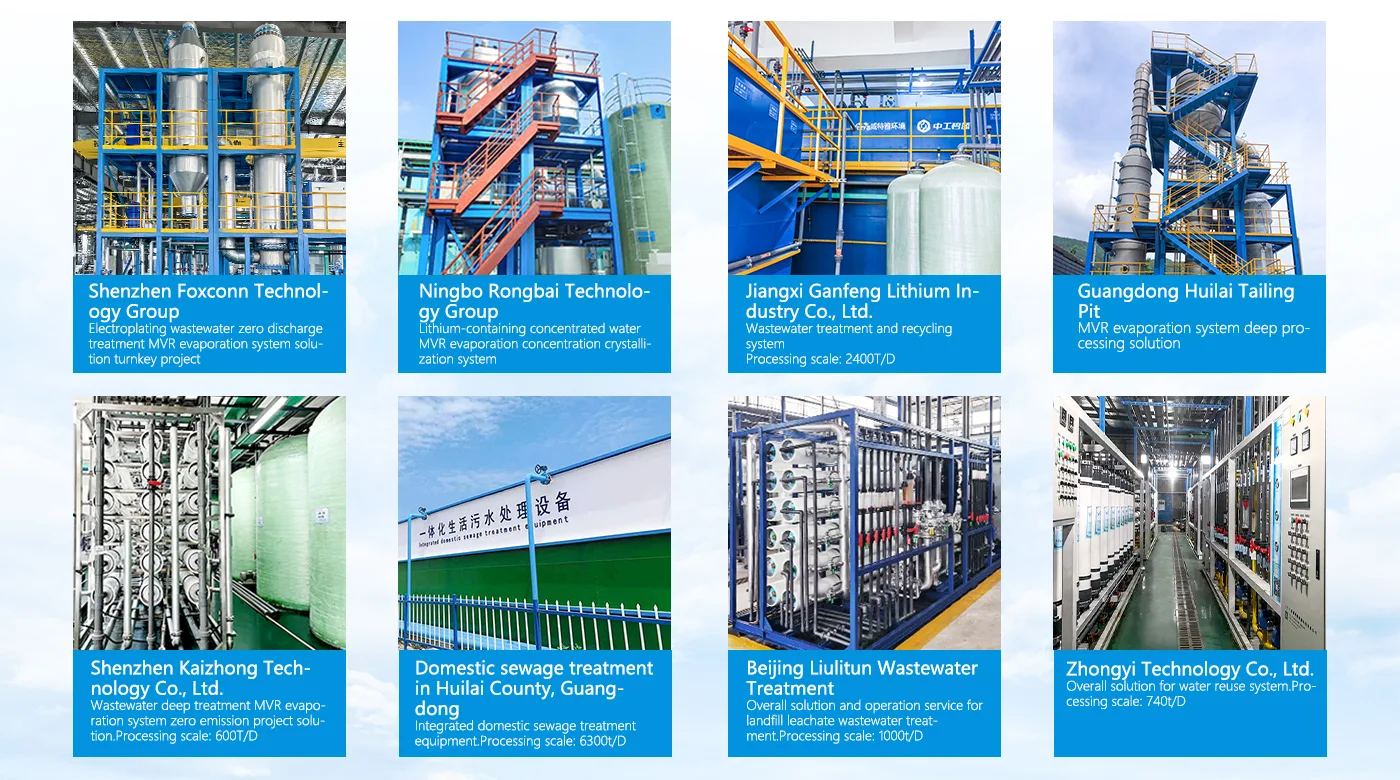
Where those conditions hold, the applications are broad: coal chemical gasification and methanol wash wastewater, flue gas desulfurization blowdown from power plants, landfill leachate concentrate at 50,000 to 100,000 mg/L TDS, chemical mother liquors, plating and surface treatment rinse water, and reverse osmosis concentrate from 10,000 to 50,000 mg/L. Units are built across a capacity range of 1 to 100 t/h of evaporation and are commonly designed for 8,000 operating hours per year.
Choosing the Right Crystallizer Type
Four configurations dominate. The OSLO design uses a suspended bed and a central downcomer to release supersaturation in the fluidized zone, and is favoured where large, uniform industrial salt crystals in the 200 to 800 micron range and high recovery matter. The DTB design adds a draft tube, baffle and elutriation leg for internal circulation, giving the narrowest particle size distribution and the most effective fines destruction — the usual pick for high-value products in fine chemicals and salt derivatives. Forced external circulation pushes slurry at high velocity through the heat exchanger, making it the most tolerant of scale-prone, viscous or suspended-solids streams. Fluidized bed crystallizers suit smaller capacities where large crystals are wanted. Compared with a batch evaporator feeding a separate crystallization vessel, a continuous crystallizer delivers higher throughput, more consistent quality and far lower labour, at the cost of higher capital outlay and a tighter demand on process stability.
Key Design Parameters That Decide Success
Crystallizer performance is decided at the design stage. Operating vacuum is normally held between -0.05 and -0.09 MPa, corresponding to boiling points of 50 to 90 degrees Celsius, with a boiling point elevation of 5 to 20 degrees Celsius at high salt concentration. Target crystal size (D50) is set at 100 to 500 microns, slurry density at 15% to 30% by weight, and residence time at 1 to 4 hours. Circulation ratio runs between 20 and 80, which yields a tube velocity of 1.5 to 2.5 m/s and a per-pass temperature rise limited to 2 to 5 degrees Celsius so that salt does not precipitate on the heat transfer surface. Design heat transfer coefficients for crystallization service typically fall in the range of 800 to 2,000 W/m2K.
Two details are routinely underestimated. Vacuum capacity should carry 20% to 30% margin, because vacuum excursions destroy the supersaturation balance faster than any other disturbance. And seed dosing, normally 1% to 5% of the solids inventory at 30 to 100 microns, must be delivered wet to avoid dust. Small-scale pilot testing before scale-up is not optional: without it, particle size targets are frequently missed on first start-up.
Material Selection: 316L, 2205 or Titanium?
Corrosion and erosion together dictate the metallurgy. Below 5,000 mg/L chloride at pH 4 to 10, 316L is sufficient, and a carbon steel shell with 316L cladding is a cost-effective choice for sulfate systems. Between 5,000 and 20,000 mg/L chloride, 2205 duplex stainless steel is the standard for tubes, slurry piping and pump impellers, thanks to a pitting resistance equivalent number above 35. Above 20,000 mg/L chloride, or where bromide is present, titanium grade 2 or grade 10 is used. Abrasive service calls for duplex or high-chromium white iron impellers and ceramic or polyurethane lined bends. Wall thickness should carry 1 to 2 mm of corrosion allowance, with additional wear allowance in slurry-swept areas.
Why Choose WTEYA
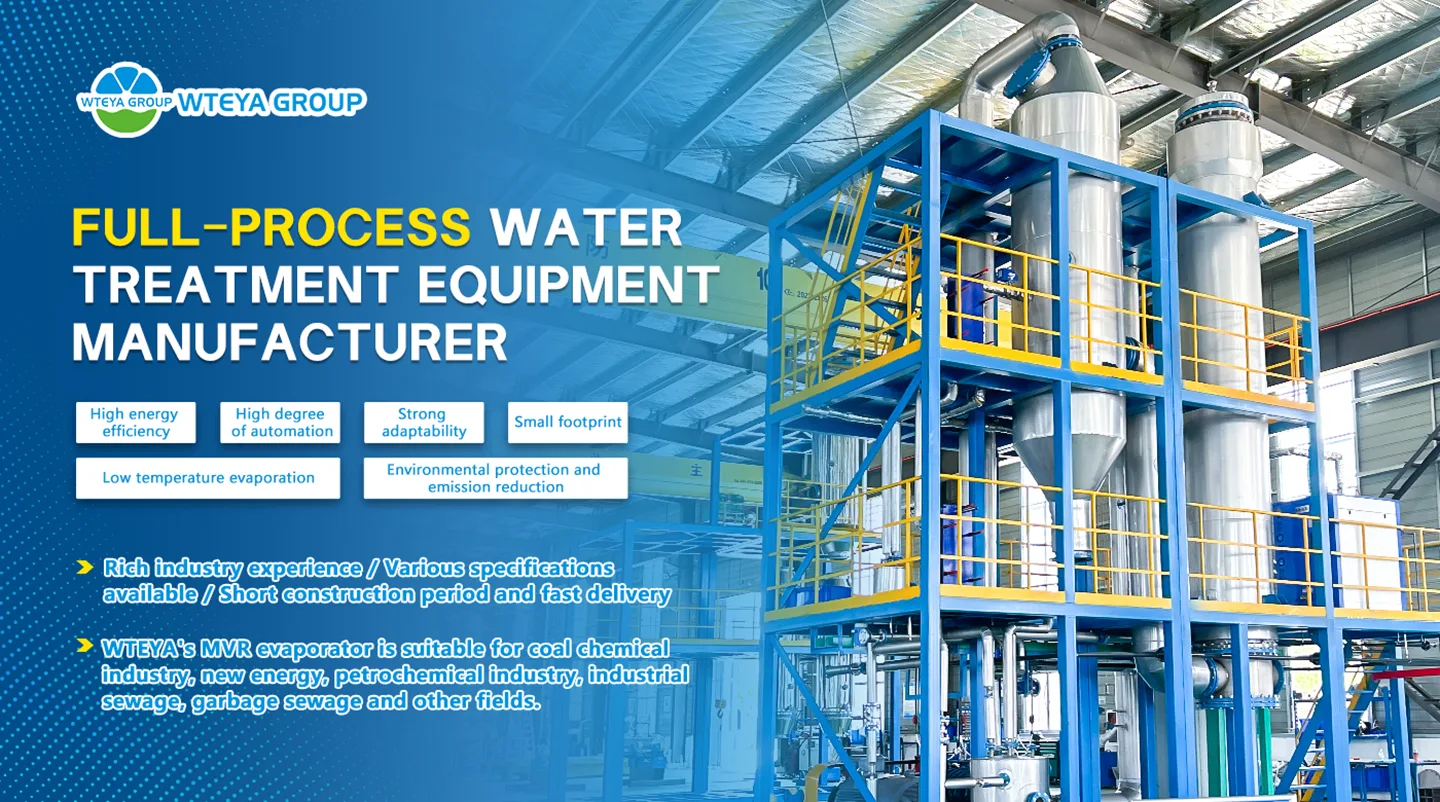
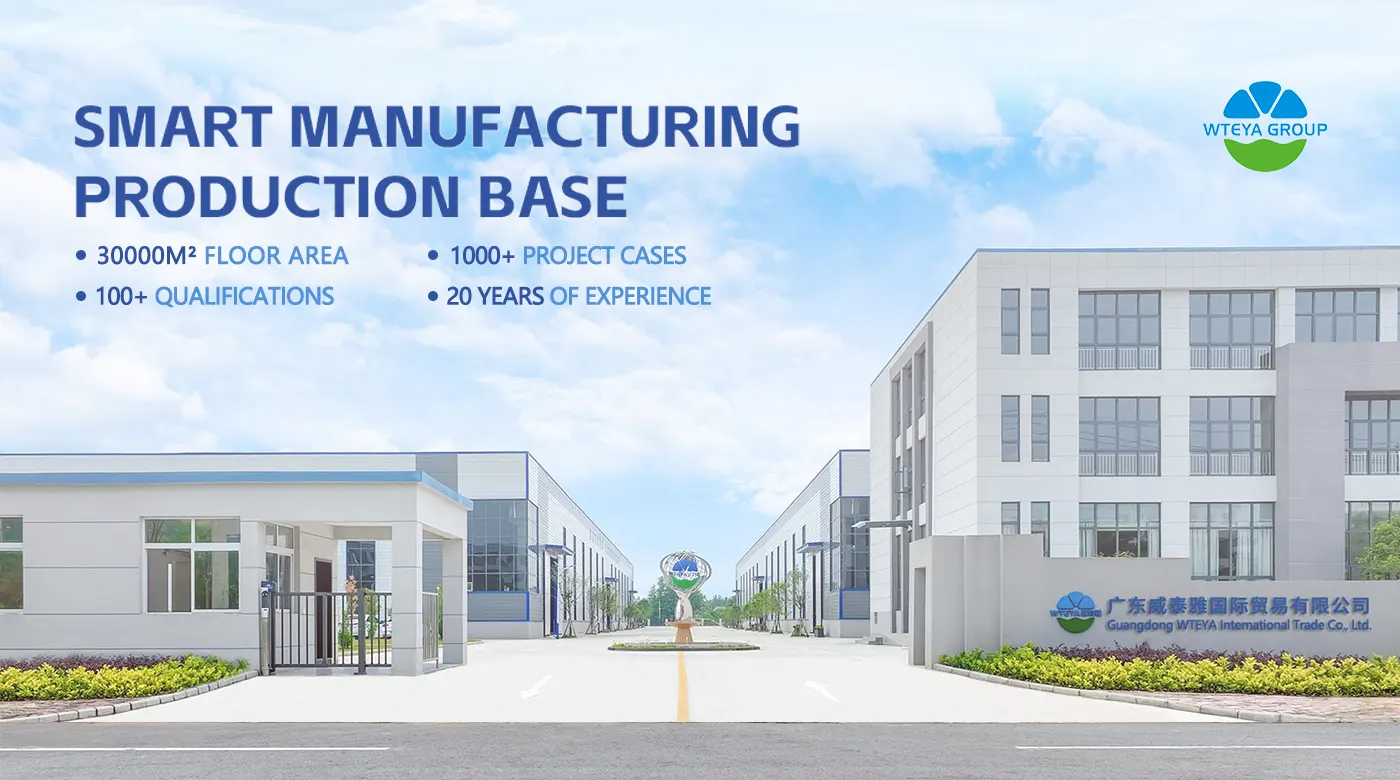
WTEYA has focused on evaporation and crystallization equipment for nearly 20 years, serving 2,000-plus industrial clients. The company engineering teams work from a full water analysis, through solubility and phase diagram assessment, thermo-mechanical calculation and pilot verification, to detailed design and start-up. Systems combine MVR compressors or multi-effect evaporation with OSLO, DTB and forced circulation crystallizer bodies, which is why steam consumption in a complete train can be brought down to 0.1 to 0.3 tons per ton of water evaporated with electrical demand of 30 to 60 kWh per ton, compared with roughly 1.1 tons of steam per ton of water for a single-effect evaporator and about 0.4 tons for three effects. Where electricity is cheap and steam is expensive, MVR crystallization is normally the economic choice; where cheap waste steam is available, multi-effect remains competitive.
Frequently Asked Questions
Q: How to choose the right solution?
A: Consider your industry, capacity requirements, and environmental regulations. Contact WTEYA for expert guidance.
Q: What is the typical project timeline?
A: Project timelines vary based on capacity and complexity. WTEYA provides detailed project schedules during consultation.
Get Your Free Consultation Today
Looking for a customized solution for your industry? Our team of experts is ready to help you design the most cost-effective and energy-efficient system for your specific needs.
Contact us today to discuss your project requirements and get a personalized quote.
📱 WhatsApp: +86-1800 2840 855
✉ Email: info@vteya.com
🌐 Website: www.vteya.com
Front page of Cross
Next go-to page
Related information
Evaporation Crystallizer: How It Works and When to Use It
Evaporation Crystallizer: How It Works and When to Use It An evaporation crystallizer sits at the very end of a zero liquid discharge line, where two questions have to be answered at once: where does the water go, and where does the salt go.
WTEYA Concludes a Successful Run at ICIF China 2026 in Shanghai
WTEYA concluded a successful three-day run at ICIF China 2026 in Shanghai, displaying a 5 t/h MVR heat exchanger, mother liquor drying equipment and a membrane skid to chemical and lithium-battery project teams.
WTEYA Strengthens South America Channel with Chilean Desalination Partner
WTEYA is expanding its seawater desalination business into South America, working with a Chilean distributor to bring skid-mounted and containerized desalination solutions to industrial and municipal water users.
WTEYA at ICIF China 2026: Day One Live from Shanghai
WTEYA showcases five core industrial wastewater treatment equipment lines at ICIF China 2026 (Shanghai, Booth E5D40).
MVR Evaporator for Copper Foil Industry Wastewater
MVR Evaporator for Copper Foil Industry Wastewater Copper foil is the conductive backbone of lithium-ion batteries and printed circuit boards, and making it is a wet, acid-heavy process.
MVR vs Multi-Effect Evaporator: Which Fits Your Plant?
MVR vs Multi-Effect Evaporator: Which Fits Your Plant? Both MVR and multi-effect evaporation do the same job: they take water out of a concentrated stream and leave you with a manageable brine or a crystallised salt.
Guangdong WTEYA Environmental Technology Co., Ltd
Contact us
WhatsApp: +86 1800 2840 855
Tel: +86-0769-28636053
+86-0769-28636126
Email: info@wteya.com
Add: Floor 14, F4 building, TianAn digital town,
Nancheng District, Dongguan,Guangdong, China