


MVR Evaporator Material Selection: 316L, 2205 or Titanium?
Release Time:
2026-11-16 09:05

MVR Evaporator Material Selection: 316L, 2205 or Titanium?
Every MVR evaporator quotation eventually reaches the same question: which alloy for the heat exchanger, the separator, the circulation pipework and the pump casings? The answer decides not only the purchase price but the service life of the whole train. A unit built in 316L that runs on a chloride-loaded brine will show pitting within a year or two, while a titanium body specified for a mild stream simply adds cost that no one recovers.
Material selection is therefore not a matter of picking the most expensive option. It is an exercise in matching alloy to the actual chemistry the wetted surfaces will see, at the temperature and concentration the evaporator will actually run at. This article sets out how the three mainstream choices behave, where each one reaches its limit, and which details are usually overlooked.

⚙️ Three Variables That Decide the Alloy
The first variable is chloride concentration. Chloride destroys the passive film on stainless steel locally, producing pitting and crevice attack rather than uniform thinning. What matters is not the chloride in the feed but the chloride in the circulating brine, which can be five to ten times higher once the evaporator has concentrated the stream.
The second variable is temperature. Chloride stress corrosion cracking in austenitic stainless steels becomes a real risk above roughly 60 °C, and an MVR evaporator by definition operates at an elevated boiling point. A stream that is harmless in a tank at ambient temperature can crack a 316L tube bundle at 90 °C.
The third variable is the environment around the metal: pH, dissolved oxygen, and whether the surface is continuously wetted or intermittently wet. Acidic brines with low oxygen are less aggressive to some alloys and more aggressive to others, and stagnant zones such as shell-side baffles, flanges and instrument pockets are where failures usually begin. Suspended solids add erosion-corrosion on top of all three.
🧪 316L: The Default Choice and Its Ceiling
316L austenitic stainless steel, with about 17% chromium, 2.5% molybdenum and a low carbon content, is the default for evaporator bodies handling low-chloride streams. Its pitting resistance equivalent number sits around 24 to 26, which is adequate for neutral, aerated liquors with chloride below a few hundred milligrams per litre and temperatures under about 60 °C.
Above that, the alloy runs out of margin. Pitting initiates at chloride levels in the low hundreds of milligrams per litre once the temperature climbs, and chloride stress corrosion cracking can appear in the vapour space and at welds where residual stress has not been relieved. The failure pattern is deceptive: the unit looks clean, then a pinhole appears through a tube wall and the condenser is contaminated before anyone notices.
There is still a legitimate role for 316L. Food-grade and non-salty process streams, condensate polishing loops, and the lower-temperature stages of a multi-stage train can all use it safely, and using it there keeps the capital cost of the plant in proportion. The mistake is to carry it into the high-chloride, high-temperature stage because the datasheet allowed it in a different duty.
🛡️ Duplex 2205: The Workhorse for Moderate Brine
Duplex stainless steel 2205 combines an austenitic and a ferritic microstructure, roughly 22% chromium, 3% molybdenum and 0.15 to 0.2% nitrogen. Its pitting resistance equivalent number is about 34 to 36, roughly ten points above 316L, and its yield strength is close to double. That combination buys chloride tolerance in the range of one to three thousand milligrams per litre, depending on temperature, together with far better resistance to chloride stress corrosion cracking.
For most industrial wastewater evaporators this is the practical answer. Brines from chemical plants, landfill leachate treatment, battery and surface treatment lines commonly sit in that chloride band, and 2205 handles them at boiling temperatures without the cost jump to titanium. The higher strength also allows thinner tube walls and lighter shells, which partly offsets the higher price per kilogram.
Duplex has its own rules. It must be welded with the correct filler and heat input to preserve the phase balance, and the heat-affected zone needs proper post-weld cleaning. Fabricators who treat 2205 like 316L produce welds that corrode preferentially. The alloy is also unsuitable for sustained operation above roughly 300 °C because of sigma phase formation, which is not an issue in an evaporator but matters in adjacent hot equipment.
💎 Titanium Grade 2: For Saturated Chloride Duty
Commercially pure titanium grade 2 is the reference material for seawater, saturated sodium chloride brines and any stream where chloride is measured in tens of grams per litre. Its passive titanium oxide film is stable in chloride environments to the point where pitting simply does not occur in normal evaporator service, and it tolerates high velocities that would erode a stainless steel tube inlet.
The limitation is temperature and crevice geometry rather than bulk chloride. Above roughly 70 to 80 °C, tight crevices such as tube-to-tubesheet joints, gasket faces and deposits under sludge can initiate crevice corrosion, so the design has to eliminate stagnant gaps rather than rely on the alloy alone. Titanium is also attacked by dry chlorine gas and by some strongly reducing acid streams, none of which belong in an evaporator feed but which occasionally arrive with a waste stream.
Cost is the other consideration. Titanium tube and plate typically cost four to six times more than 316L and roughly two to three times more than 2205. A common compromise is a titanium tube bundle in a duplex or rubber-lined shell, or titanium only on the stage that sees the highest chloride, which keeps the benefit where it is actually needed.
📊 Side-by-Side Comparison
The table below summarises the practical envelope used when specifying an evaporator. Values are typical for continuous service in neutral to slightly alkaline brines and should be confirmed against the actual water analysis rather than treated as universal limits.
- 316L stainless steel — pitting resistance number 24 to 26; chloride up to a few hundred mg/L; temperature ceiling around 60 °C; relative material cost 1.0.
- Duplex 2205 — pitting resistance number 34 to 36; chloride roughly 1,000 to 3,000 mg/L; service to boiling point in most brines; relative cost 1.5 to 2.0.
- Titanium grade 2 — pitting effectively absent in chloride brines; suitable from seawater to saturated NaCl; crevice attention above 70 to 80 °C; relative cost 4.0 to 6.0.
- Thermal conductivity — 316L about 16 W/m·K, 2205 about 19 W/m·K, titanium about 21 W/m·K; differences are small compared with the effect of fouling and wall thickness.
🔧 Where Material Choice Is Usually Got Wrong
Failures rarely occur in the middle of a tube. They occur at the joints, the welds and the places where the process stops moving. A specification that names the alloy but ignores these details has not solved the corrosion problem.
- Crevices at tube-to-tubesheet joints. Rolled joints leave a gap that concentrates chloride and depletes oxygen. Seal welding or expanded-then-welded joints are worth the extra cost in any chloride service.
- Stagnant pipe runs and instrument pockets. Dead legs hold brine at a different temperature and oxygen level from the bulk. They should be eliminated at the design stage, not flushed later.
- Dissimilar metal contacts. A carbon steel support in contact with a wetted stainless surface creates a galvanic cell. Insulating washers and painted interfaces are cheap insurance.
- Insulation that hides leaks. Chloride-bearing moisture trapped under insulation causes external stress corrosion cracking, which is often mistaken for a process-side failure.
- Vapour space and condensate side. The condensate is low in chloride but the vapour space can concentrate droplets. Materials on the demister and the top head deserve the same review as the tubes.
🏭 How WTEYA Specifies Materials per Project
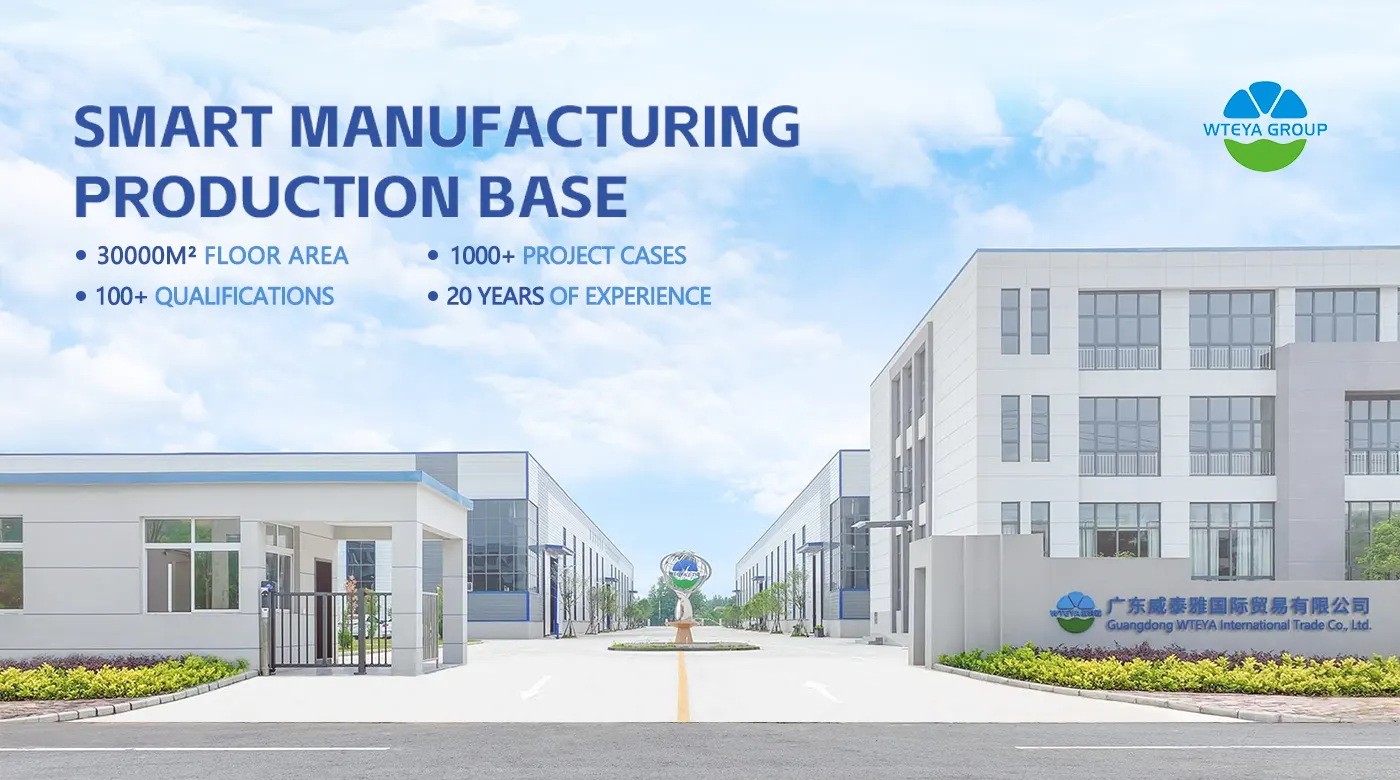
WTEYA builds evaporation and crystallization systems as engineered equipment rather than catalogue items, so the alloy is selected against the customer's water analysis, operating temperature and concentration factor. The company has nearly twenty years of experience in evaporation and has supplied more than 2,000 customers, with its own manufacturing base in Jingshan covering 30,000 square metres.
In practice that means a project starts with the brine chemistry and the concentration ratio, not with a standard bill of materials. Where the chloride profile changes through the train, different stages can use different alloys, so the expensive material is confined to the stage that needs it. Fabrication, welding procedure qualification and post-weld treatment are handled in-house, and customized solutions as well as full OEM and ODM services are available for partners who need their own configuration.
That approach also covers the items that sit outside the evaporator proper: circulation pumps, forced circulation pipework, crystallizer bodies and the salt handling equipment. Specifying the heat exchanger in 2205 and the pump casing in cast iron is a common way to lose the benefit within two years, and it is exactly the kind of mismatch a project review is meant to catch.
❓ Frequently Asked Questions
Can 316L be used if the feed chloride is low?
Yes, provided the chloride in the concentrated brine stays within the alloy's envelope and the operating temperature stays below roughly 60 °C. Because an evaporator concentrates chloride several-fold, the feed value must be multiplied by the concentration factor before the decision is made, and the margin should be checked against the highest expected chloride rather than the annual average.
Is duplex 2205 always better than 316L?
It is more corrosion resistant and stronger, but it costs more and demands stricter welding discipline. For genuinely low-chloride, low-temperature duty, 316L is the more economical and perfectly adequate choice. Duplex earns its price in the middle band of chloride and temperature where 316L fails but titanium is not yet justified.
When is titanium unavoidable?
When the brine approaches sodium chloride saturation, when the feed is seawater or a high-chloride industrial stream, or when the operating temperature pushes chloride stress corrosion beyond what duplex can tolerate. In those duties the alternative is not a cheaper alloy but a shorter service life and unplanned shutdowns.
Let's Build Your Solution Together
Don't let wastewater challenges hold back your operations. WTEYA has helped 100+ manufacturers achieve compliance and reduce costs by up to 50%.
Request your free technical assessment and discover how we can optimize your MVR evaporation process.
📱 WhatsApp: +86-1800 2840 855
✉ Email: info@vteya.com
🌐 Website: www.vteya.com
Front page of Cross
Next go-to page
Related information
Full-Process Leachate Treatment for Septic Waste Operators
How full-process leachate treatment works for septic and liquid waste operators: pretreatment, MVR evaporation for volume reduction and membrane polishing.
MVR Evaporator Material Selection: 316L, 2205 or Titanium?
MVR Evaporator Material Selection: 316L, 2205 or Titanium? Every MVR evaporator quotation eventually reaches the same question: which alloy for the heat exchanger, the separator, the circulation pipework and the pump casings? The answer decides not only the purchase price but the
FGD Wastewater Zero Discharge: An MVR-Based Approach
FGD Wastewater Zero Discharge: An MVR-Based Approach Flue gas desulfurization (FGD) wastewater is one of the most aggressive streams a power plant or industrial boiler house has to manage. It is acidic, saturated with gypsum, loaded with chloride and heavy metals, and it arrives
How Much Floor Space Does an MVR Evaporator Need?
Answer: The floor space an MVR evaporator needs depends on evaporation capacity and equipment type. A rough planning figure is 10–20 m² of floor area per 1 t/h of evaporation capacity .
MVR vs Single Effect Evaporator: Energy Consumption Compared
MVR vs Single Effect Evaporator: Energy Consumption Compared Evaporation is an energy business. Whichever evaporator you install, the plant will spend most of its operating budget turning water into vapor and then getting rid of that vapor.
Energy Recovery in Evaporation: 5 Ways to Save Steam
Energy Recovery in Evaporation: 5 Ways to Save Steam In an industrial evaporation plant, thermal energy is usually the largest single operating cost — commonly 60–80% of the total , ahead of electricity, labour and chemicals.
Guangdong WTEYA Environmental Technology Co., Ltd
Contact us
WhatsApp: +86 1800 2840 855
Tel: +86-0769-28636053
+86-0769-28636126
Email: info@wteya.com
Add: Floor 14, F4 building, TianAn digital town,
Nancheng District, Dongguan,Guangdong, China