


Full-Process Leachate Treatment for Septic Waste Operators
Release Time:
2026-11-16 09:35

Full-Process Leachate Treatment for Septic Waste Operators
For a septic and liquid waste operator, leachate treatment is the line where the business either scales or stalls. Collection is a familiar problem: trucks, drivers, routes, customers. What decides profitability is how much of each tanker load has to leave the site again as liquid, and what quality standard that liquid must meet before it can be discharged. This article sets out the process route WTEYA builds for such operators — the same route we walked through with Mac Waste Group, an Australian liquid waste operator, in November 2026 — and the reasoning behind each stage.
Why Landfill Leachate Treatment Is Difficult for Liquid Waste Receivers
Septage, grease trap waste and landfill leachate share one property that makes them hard to treat: they are not a product, they are a mixture. Chemical oxygen demand in leachate commonly sits in the thousands of milligrams per litre and can rise by an order of magnitude after heavy rain, because infiltration through the waste body dissolves another fraction of the material. Ammonia nitrogen follows the same pattern, and in the mature phase of a landfill it becomes the dominant pollutant.
Salinity adds a second problem. Chloride and total dissolved solids accumulate as water evaporates and re-infiltrates, so a stream that is easy to treat biologically in one season can become hostile to activated sludge in the next. Heavy metals, oil and grease, and grit from tanker unloading arrive on top of that. A treatment train designed around average values will fail in the season that matters, which is why leachate treatment design starts with the worst week, not the average one.

Step One: Pretreatment That Protects Everything Downstream
Every full-process line begins with removal of what cannot be evaporated or filtered economically. Screening and grit removal take out material that would erode pumps and block heat exchangers. Oil and grease separation, usually with dissolved air flotation and chemical dosing, removes the fraction that would otherwise coat heating surfaces and cut heat transfer. Coagulation and sedimentation follow where suspended solids are high, and sludge goes to dewatering rather than back into the feed.
Where ammonia nitrogen is high and the discharge standard is tight, stripping or biological pretreatment is placed ahead of evaporation. This is a cost decision as much as a technical one: nitrogen removed biologically is cheaper per kilogram than nitrogen carried through an evaporator into the condensate. MBR biological treatment often suits streams that are biodegradable enough, because it cuts organic load and volume in one step.

Step Two: MVR Evaporation for Leachate Volume Reduction
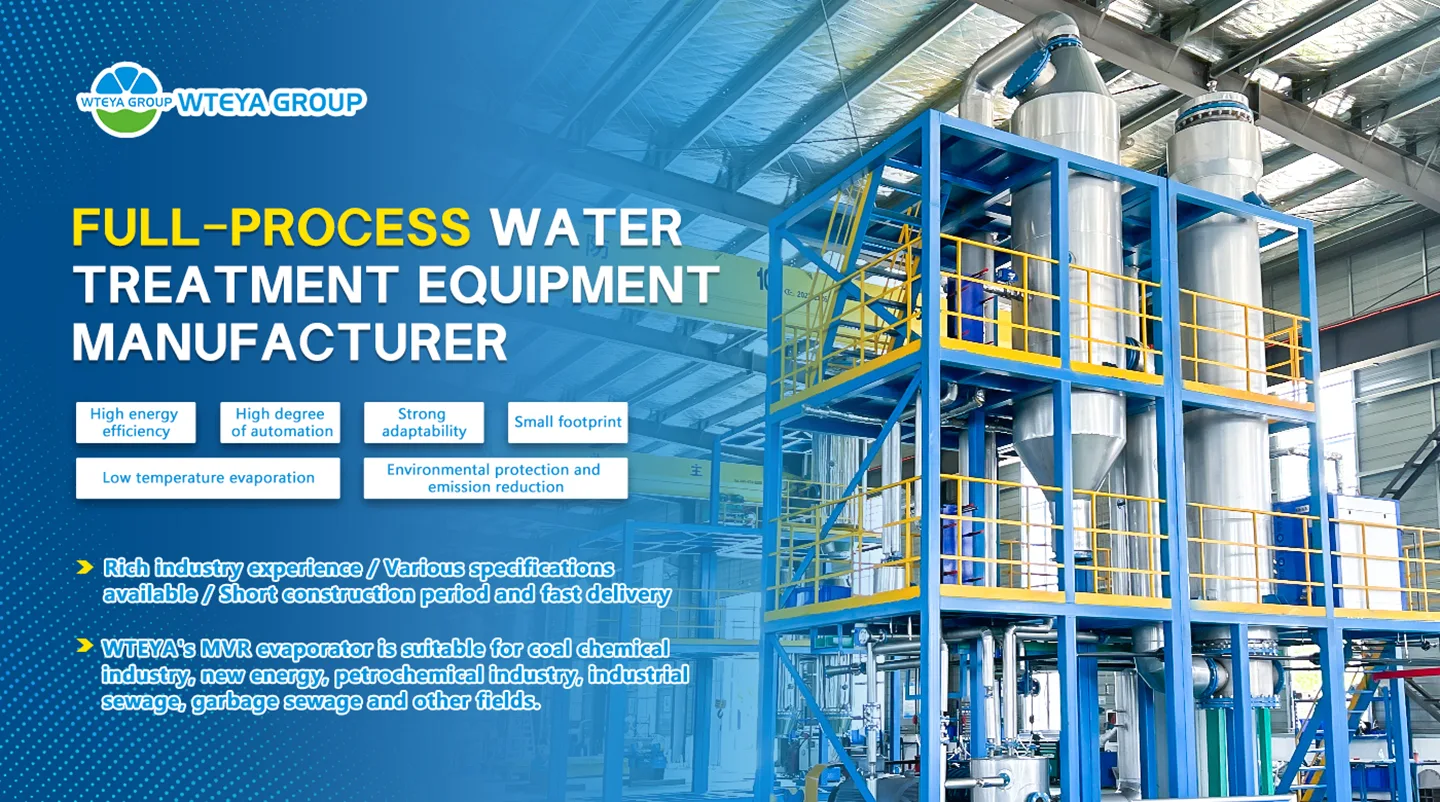
Mechanical vapour recompression is the stage that changes the arithmetic. Instead of boiling the liquid with fresh steam, the evaporator compresses its own vapour and reuses it as the heating medium, so the electrical input replaces most of the thermal input. The result is a concentrate — a small fraction of the incoming volume, holding the salts and the non-volatile organics — and a distillate that is already close to reusable quality.
For an operator, the practical consequence is simple: the volume that still has to be transported, or crystallized, falls from the whole tanker load to a residual stream. That is where MVR evaporation for leachate earns its place in the line. The design constraints are practical. Scaling from calcium and magnesium salts must be managed by softening or by operating below the saturation point; foaming from high organic content needs antifoam dosing and adequate vapour space; and the compressor must hold performance across a boiling point elevation that changes as the concentrate thickens.

Step Three: Membrane Polishing for Discharge or Reuse
Evaporator distillate is clean but not automatically compliant. Volatile organics and ammonia can carry over, and the condensate still has to meet whatever limit applies. Reverse osmosis or nanofiltration polishes the stream, and where the standard is very tight, activated carbon or advanced oxidation removes the residual fraction that membranes cannot. The polishing concentrate returns to the evaporator instead of leaving the plant as waste, which closes the loop.
If the site has to reach zero liquid discharge, a crystallizer follows the evaporator and the liquid fraction disappears entirely, leaving a stable solid residue. Most operators need not go that far on day one, but the line should be laid out so a crystallizer can be added without rebuilding the evaporation stage.

Operating Cost: Hauling Every Litre Versus Concentrating On Site
The comparison that decides the investment is not capital against capital, it is cost per cubic metre of received waste. Hauling leaves a large volume to be moved at a price per tonne that rises with distance and gate fees. On-site concentration converts most of that volume into water and a small residue, replacing transport cost with electrical energy, chemicals and maintenance.
The balance point depends on four numbers: evaporation duty per cubic metre, local electricity price, avoided haulage and gate fee, and the uptime achieved. A line that runs two shifts because of fouling costs more than its power consumption suggests — which is why cleaning intervals belong in the cost model, not in the service contract afterwards.

Why Choose WTEYA
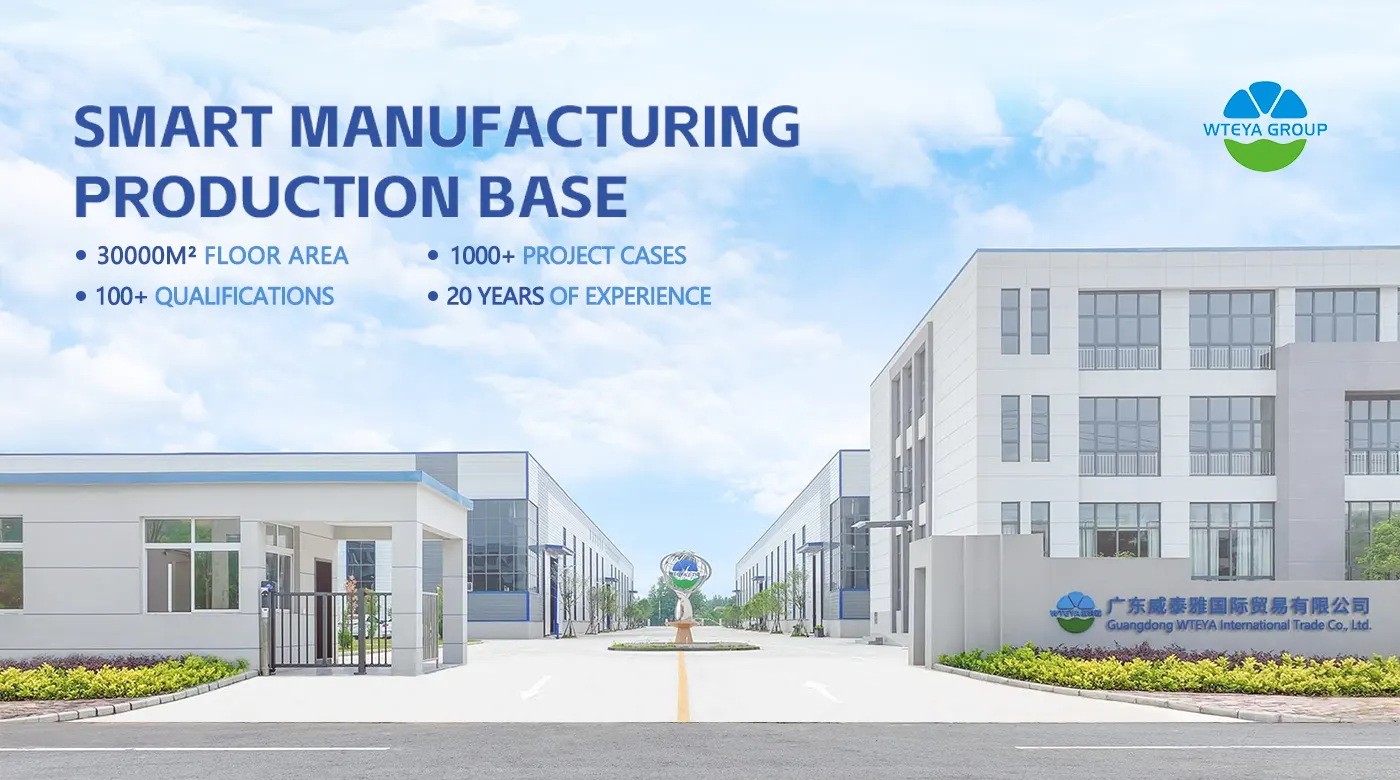
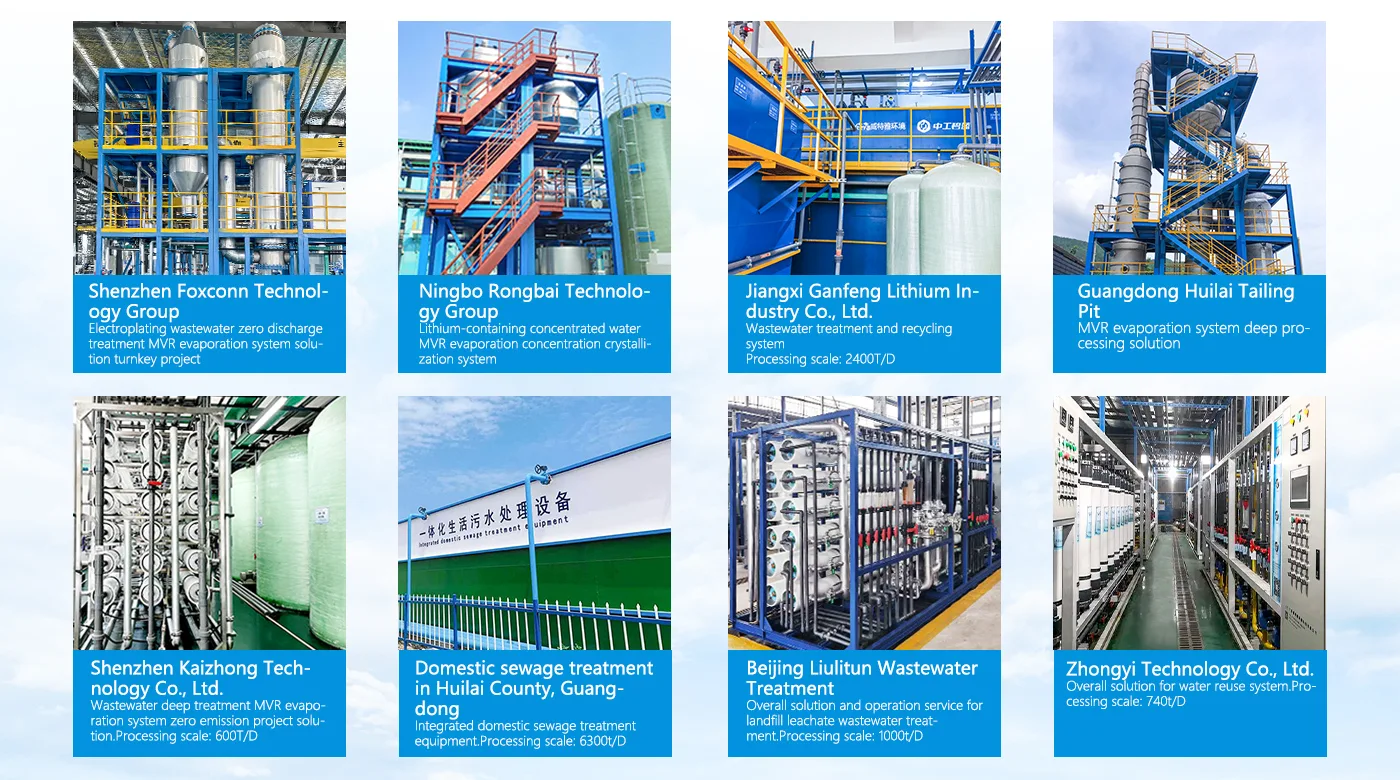
WTEYA designs and manufactures the whole train — pretreatment, MVR evaporation, membrane polishing and crystallization — rather than integrating bought-in modules, so a single engineering team owns the mass balance and the performance guarantee. Nearly 20 years of leachate and high-salinity work, with more than 100 commissioned projects, has produced standard skids for common cases and a design process for the difficult ones.
For export clients this shows in in-house documentation and packing, remote commissioning against the plant's own data, and a spare parts list agreed at handover.

Frequently Asked Questions
Q: What capacity does a full-process leachate treatment line need to be viable?
A: Viability depends more on disposal cost than on capacity. A small line handling a few cubic metres per day can pay back where haulage and gate fees are high, while a large line in a low-cost disposal market may not. Start from the avoided cost per cubic metre, then set capacity from the volume actually received.
Q: How is foaming and scaling controlled in an MVR evaporator treating leachate?
A: By pretreatment and by operating regime rather than by chemicals alone: softening or pH adjustment to keep hardness salts below saturation, adequate vapour space and antifoam for organic foaming, and a cleaning-in-place circuit designed for the actual fouling mechanism. The pilot trial is where these are confirmed.
Q: Can the concentrate be disposed of without a crystallizer?
A: Yes, in most cases. The concentrate is a small fraction of the feed and can be transported to a licensed facility, which is often cheaper than owning a crystallizer. The line is laid out so that crystallization can be added later if disposal costs or regulations change.
Let's Build Your Solution Together
Don't let wastewater challenges hold back your operations. WTEYA has helped 100+ manufacturers achieve compliance and reduce costs by up to 50%.
Request your free technical assessment and discover how we can optimize your landfill leachate process.
📱 WhatsApp: +86-1800 2840 855
✉ Email: info@vteya.com
🌐 Website: www.vteya.com
Front page of Cross
Next go-to page
Related information
Full-Process Leachate Treatment for Septic Waste Operators
How full-process leachate treatment works for septic and liquid waste operators: pretreatment, MVR evaporation for volume reduction and membrane polishing.
MVR Evaporator Material Selection: 316L, 2205 or Titanium?
MVR Evaporator Material Selection: 316L, 2205 or Titanium? Every MVR evaporator quotation eventually reaches the same question: which alloy for the heat exchanger, the separator, the circulation pipework and the pump casings? The answer decides not only the purchase price but the
FGD Wastewater Zero Discharge: An MVR-Based Approach
FGD Wastewater Zero Discharge: An MVR-Based Approach Flue gas desulfurization (FGD) wastewater is one of the most aggressive streams a power plant or industrial boiler house has to manage. It is acidic, saturated with gypsum, loaded with chloride and heavy metals, and it arrives
How Much Floor Space Does an MVR Evaporator Need?
Answer: The floor space an MVR evaporator needs depends on evaporation capacity and equipment type. A rough planning figure is 10–20 m² of floor area per 1 t/h of evaporation capacity .
MVR vs Single Effect Evaporator: Energy Consumption Compared
MVR vs Single Effect Evaporator: Energy Consumption Compared Evaporation is an energy business. Whichever evaporator you install, the plant will spend most of its operating budget turning water into vapor and then getting rid of that vapor.
Energy Recovery in Evaporation: 5 Ways to Save Steam
Energy Recovery in Evaporation: 5 Ways to Save Steam In an industrial evaporation plant, thermal energy is usually the largest single operating cost — commonly 60–80% of the total , ahead of electricity, labour and chemicals.
Guangdong WTEYA Environmental Technology Co., Ltd
Contact us
WhatsApp: +86 1800 2840 855
Tel: +86-0769-28636053
+86-0769-28636126
Email: info@wteya.com
Add: Floor 14, F4 building, TianAn digital town,
Nancheng District, Dongguan,Guangdong, China